Planning a fundraiser and considering Hosting a Raffle? A well-organized raffle can give your school, church, nonprofit, sports team, or community organization a simple way to engage supporters while raising money for a specific goal.
But a successful raffle involves more than printing tickets and picking a winner. You need to plan the prize, ticket price, sales process, drawing, recordkeeping, ticket design, and applicable state requirements before you start selling.
This guide explains Creating a Raffle from the planning stage through the final drawing, including how raffle tickets work, what information belongs on them, how to choose Raffle Ticket Dimensions, how to create a Raffle Rules Template, and when professionally printed Custom Raffle Tickets make sense.
A raffle typically works by selling numbered entries for a chance to win one or more prizes. The organizer establishes the rules and drawing details, sells eligible tickets, records the entries, and randomly selects the winner or winners at the announced drawing.
What Is a Raffle?
A raffle is a chance-based fundraising activity in which participants purchase or receive entries and one or more winning entries are selected through a drawing.
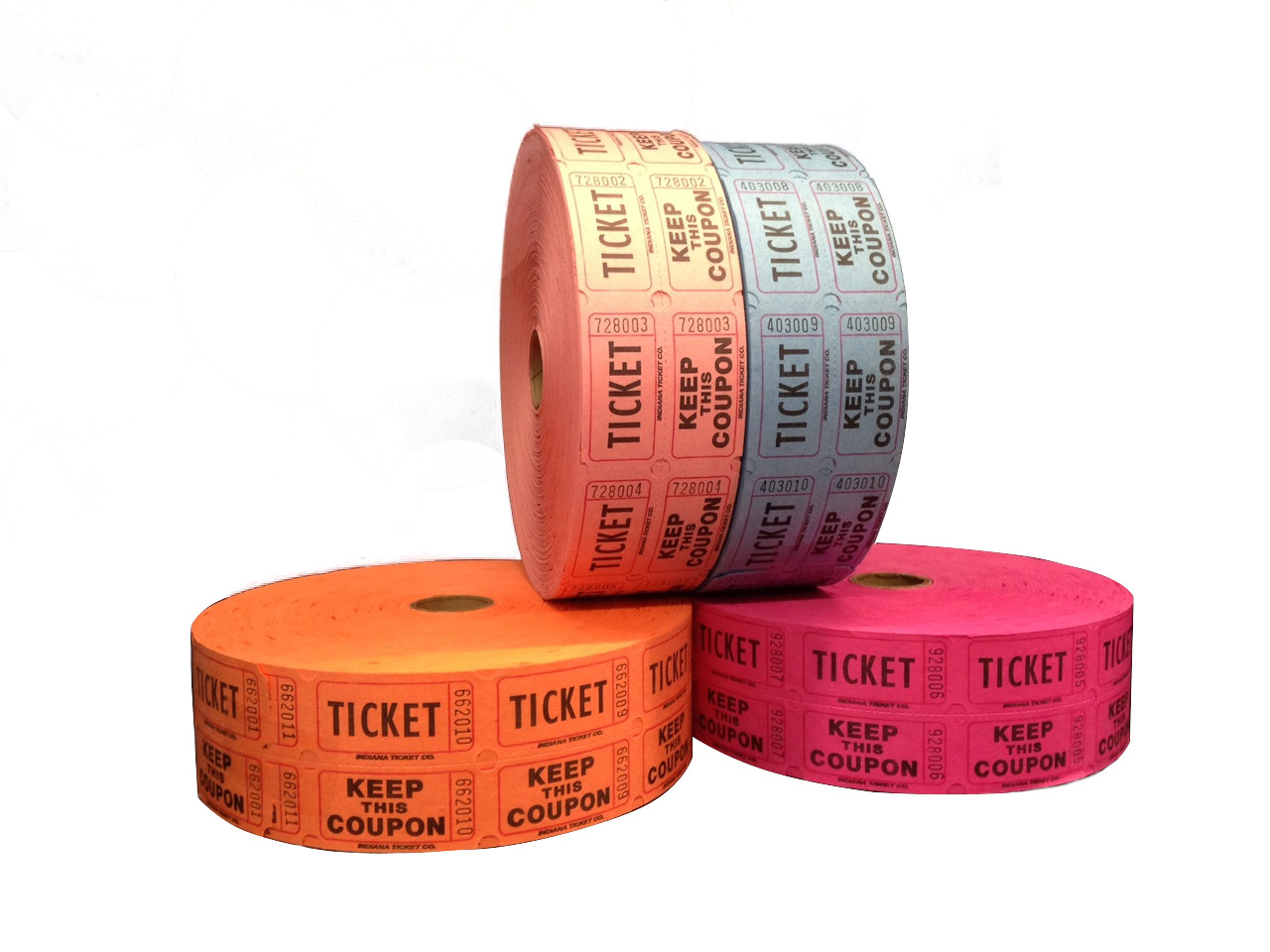
A traditional physical raffle usually uses numbered tickets with a detachable stub. One portion goes to the participant while the matching portion is retained for the drawing.
Raffles can be used by organizations such as:
- Schools and PTOs
- Churches and religious organizations
- Nonprofits and charities
- Youth sports teams
- Community organizations
- Clubs and associations
- Fundraising event organizers
The exact legal requirements depend on where the raffle takes place. In the United States, raffle rules can vary significantly by state and may address who can conduct a raffle, whether a permit is required, ticket sales, prizes, drawing procedures, recordkeeping, and advertising.
Always verify the rules that apply to your organization before selling tickets.
How Does a Raffle Work?
A raffle generally follows a straightforward process: establish the fundraiser, choose the prize, create the rules, prepare numbered tickets, sell entries, conduct the drawing, and document the result.
Here is the basic process:
- Set a fundraising goal.
- Confirm that your organization can legally conduct the raffle.
- Choose the prize or prizes.
- Set the ticket price.
- Establish the drawing date, time, and location.
- Design and print the tickets.
- Sell and distribute tickets.
- Track sold, unsold, and void tickets.
- Conduct the drawing according to the published rules.
- Contact the winner and document the outcome.
What Happens In a Raffle?
The most important operational detail is keeping the entry system organized.
If you sell physical tickets, the participant should receive their portion of the numbered ticket while the matching stub is retained for the drawing. Your sales records should make it possible to reconcile the tickets distributed, sold, returned, and remaining.
For larger events, sequential numbering and detachable stubs make the process easier to manage.
How to Plan and Host a Raffle From Start to Finish
Step 1: Define Your Fundraising Goal
Start with the amount your organization wants to raise.
For example, suppose your goal is $5,000 and you expect $500 in raffle-related expenses. Your ticket revenue target would need to cover both the fundraising goal and the expenses.
Do not choose a ticket price simply because another organization used the same amount.
Consider:
- Fundraising goal
- Prize expenses
- Printing costs
- Expected number of buyers
- Expected number of tickets sold
- Event audience
- Payment or platform costs
- Applicable taxes or regulatory expenses
For additional pricing examples, see the Raffles For Less guide to how much to charge for raffle tickets.
Step 2: Choose Your Raffle Format
Different formats can work for different events.
| Raffle format | How it works | Common use |
| Single-prize raffle | One winning ticket receives the main prize | School or community fundraiser |
| Multiple-prize raffle | Several numbered entries win different prizes | Gala or larger fundraiser |
| 50/50 raffle | Winner receives a defined share of the proceeds | Sporting and community events |
| Calendar raffle | Tickets correspond to dates and prizes | Longer fundraising campaigns |
| Basket raffle | Participants enter for specific prize baskets | School and church events |
Your format should be compatible with the laws and rules applicable to your organization and location.
Step 3: Decide How Many Tickets to Print
Estimate realistic sales instead of automatically printing as many tickets as possible.
For example:
Expected buyers × average tickets per buyer = estimated tickets needed
If you expect 300 supporters and each person may purchase about 5 tickets, your estimated sales volume would be 1,500 tickets.
Then consider whether you need additional tickets for volunteers, late sales, replacement tickets, or separate sales groups.
Raffle Rules Template: What Should Your Rules Include?
A clear Raffle Rules Template helps eliminate confusion before tickets go on sale.
Your rules can address:
- Organization conducting the raffle
- Eligibility requirements
- Ticket price
- Maximum or minimum age, where applicable
- Start and end dates
- Drawing date, time, and location
- Prize descriptions
- Winner selection method
- Whether the winner must be present
- How winners will be contacted
- How unclaimed prizes are handled
- Ticket refund or cancellation rules
- Permit or license information, when required
- Any applicable geographic restrictions
Simple Raffle Rules Template
Organization: [Organization Name]
Raffle Name: [Event/Raffle Name]
Ticket Price: $[Amount]
Drawing Date: [Date]
Drawing Time: [Time]
Drawing Location: [Location]
Prize: [Prize Description]
Eligibility: [Who may participate]
Winner Selection: [Describe drawing procedure]
Winner Notification: [Describe notification method]
Prize Claim: [Describe claim deadline and process]
Permit/License Information: [Insert if required]
Use this as a planning framework, not as a substitute for your state’s specific legal requirements.
Raffle laws can change, and requirements differ across jurisdictions. Check the applicable state regulator before printing or selling tickets.
Check the Rules Before Selling Tickets
This step should happen before your organization invests in ticket printing.
Raffles can be regulated as charitable gaming or gambling depending on the jurisdiction. Some states restrict who may conduct raffles, while others impose registration, licensing, reporting, prize, or sales requirements.
The safest workflow is:
- Identify the state and local jurisdiction governing your raffle.
- Determine whether your organization qualifies.
- Check whether a permit or registration is required.
- Review restrictions on ticket sales and advertising.
- Confirm requirements for the drawing and prizes.
- Keep copies of required records and filings.
Raffles For Less also maintains a U.S. raffle laws by state guide for general research.
Important: This article provides general information, not legal advice. Always confirm current requirements with the appropriate state or local authority.
What Information Should Go on a Raffle Ticket?
Your ticket should make the important information easy to find.
At minimum, review whether your ticket needs:
- Organization name
- Raffle or event name
- Unique ticket number
- Ticket price
- Prize information
- Drawing date
- Drawing time
- Drawing location
- Organization contact information
- Eligibility requirements
- Raffle terms
- Required permit or license information
- Winner instructions
For a more detailed breakdown, see what information to include on a raffle ticket.
Example Ticket Layout
ANNUAL COMMUNITY FUNDRAISER
Grand Prize: $2,500 Gift Package
Ticket Price: $10
Drawing Date: October 25, 2026
Drawing Time: 7:00 PM
Location: Community Center
Ticket No. 01842
DETACHABLE STUB
Ticket No. 01842
Name: __________________
Phone: __________________
The exact wording should be adjusted to your raffle rules and local requirements.
Choosing the Right Raffle Ticket Dimensions
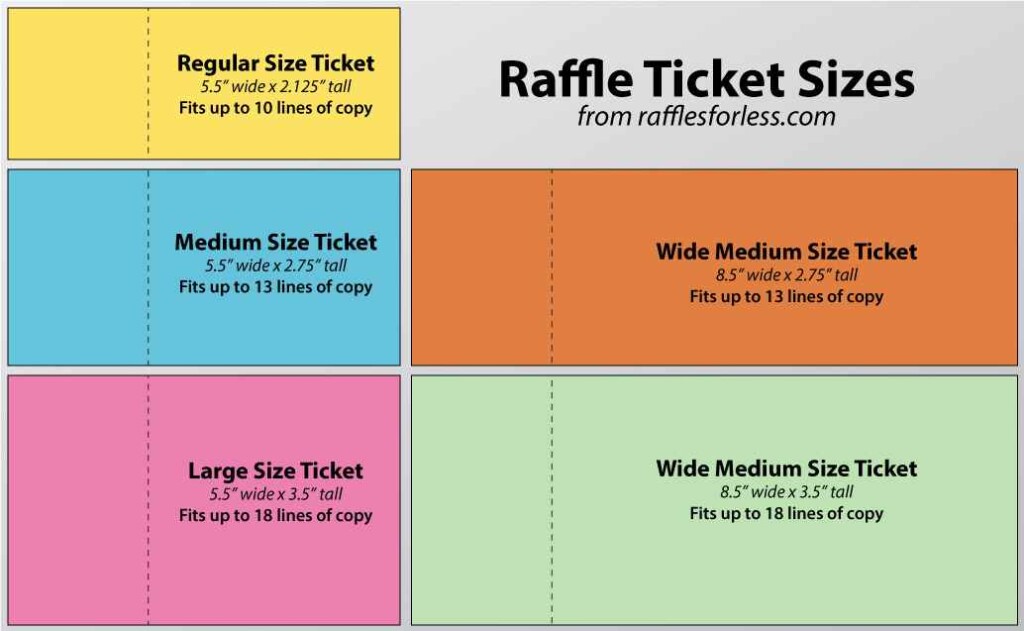
Raffle Ticket Dimensions affect both appearance and functionality.
A small ticket can be economical and easy to distribute, while a larger ticket gives you more room for prize information, sponsor recognition, terms, or event details.
Raffles For Less currently offers these standard sizes:
| Ticket size | Dimensions | Useful when |
| Regular | 2-1/8 × 5-1/2 in. | Simple raffles |
| Medium | 2-3/4 × 5-1/2 in. | More event information |
| Large | 3-1/2 × 5-1/2 in. | More copy and larger layouts |
| Wide Medium | 2-3/4 × 8-1/2 in. | Wider designs |
| Wide Large | 3-1/2 × 8-1/2 in. | Maximum design space |
Calendar raffle formats are also available.
See the complete raffle ticket size guide before choosing your format.
How to Choose a Ticket Size
Choose the smallest size that comfortably accommodates all required information.
Use a larger ticket when you need:
- Multiple prize descriptions
- Sponsor logos
- Detailed rules
- Additional contact information
- Larger graphics
- Calendar information
- More writing space on the stub
Avoid selecting a large ticket simply because it looks impressive. Extra space is useful only when your design actually needs it.
How to Make Custom Raffle Tickets
If you’re wondering How to Make Custom Raffle Tickets, start with the information rather than the artwork.
1. Gather Your Content
Collect your organization name, event name, ticket price, prize details, drawing information, contact information, rules, and any required legal wording.
2. Select the Ticket Size
Match your content requirements to the available dimensions.
3. Plan the Layout
Create a clear visual hierarchy:
Event → Prize → Price → Drawing Details → Ticket Number → Rules/Contact
Participants should be able to understand the basic purpose of the ticket within seconds.
4. Add Sequential Numbers
Each entry should have a unique number.
For physical tickets with detachable stubs, the number should correspond between the participant’s portion and the drawing stub.
5. Add Branding
Your logo, organization colors, event theme, and sponsor information can make Custom Raffle Tickets feel more professional.
6. Proof Before Printing
Check:
- Spelling
- Dates
- Times
- Prices
- Phone numbers
- Website addresses
- Ticket numbering
- Prize descriptions
- Legal wording
- Perforation location
- Overall readability
A proof is much easier to correct than thousands of finished tickets.
You can review Raffles For Less raffle ticket samples for examples of different sizes and layouts.
How Much Should Raffle Tickets Cost?
One of the most common questions organizers ask is How Much Is It Worth when evaluating a raffle prize or setting a ticket price.
There is no universal ticket price.
A useful starting calculation is:
(Fundraising goal + raffle expenses) ÷ expected tickets sold = minimum revenue target per ticket
For example:
- Fundraising goal: $5,000
- Expenses: $1,000
- Expected sales: 1,000 tickets
$6,000 ÷ 1,000 = $6 per ticket
You could then structure the offer around a simple base price and ticket bundles.
Examples:
- 1 ticket for $5
- 3 tickets for $10
- 10 tickets for $25
These are examples, not universal recommendations. Your audience, prize, costs, applicable rules, and expected demand should determine the final structure.
For more calculations, see the Raffles For Less raffle ticket pricing guide.
What Makes a Raffle Prize Valuable?
Prize value is not determined solely by the item’s retail price.
Ask:
- Would your audience actually want the prize?
- Is the value easy to understand?
- Was the prize donated or purchased?
- Are there restrictions attached to it?
- Does the prize match the event?
- Are there taxes or reporting considerations?
- Can you accurately document the stated value?
For example, a restaurant gift certificate may be more appealing to a local audience than an expensive item that few attendees want.
If you need donated prizes, see how to get raffle prize donations.
DIY Tickets vs. Professionally Printed Tickets
Both approaches can work.
| Factor | DIY | Professional printing |
| Initial setup | More hands-on | Simpler |
| Design control | High | High |
| Numbering | Usually manual/software-based | Can be professionally handled |
| Perforation | Requires equipment or pre-perforated stock | Included with suitable ticket options |
| Large quantities | More labor | Easier to manage |
| Finished appearance | Depends on equipment | Consistent |
| Best fit | Small jobs and hands-on projects | Fundraisers needing ready-to-use tickets |
DIY printing may make sense for a small event where you have the equipment and time.
Professional printing becomes more attractive when you need hundreds or thousands of numbered, perforated tickets without spending hours cutting, numbering, and assembling them.
Raffles For Less offers custom raffle ticket printing and order forms in multiple sizes and formats.
Current Raffles For Less pricing includes regular, medium, large, wide-medium, and wide-large tickets, with quantities beginning at 250 on the listed pricing page. Additional options can affect the final price. Check the current raffle ticket pricing before ordering.
Best Practices for Running a Smooth Raffle
Keep Ticket Numbers Organized
Do not mix different number ranges without a reason.
Record:
- Number range assigned
- Seller or volunteer receiving the tickets
- Tickets sold
- Tickets returned
- Tickets voided
- Unsold tickets
Separate Sold and Unsold Tickets
At the end of sales, reconcile your ticket records before the drawing.
Protect the Drawing Entries
Store physical stubs or other entries in a secure location.
Publish the Drawing Details Clearly
Participants should not have to guess when or where the winner will be selected.
Make the Drawing Transparent
Follow the published procedure consistently and document the winning ticket number.
Keep Records
Retain relevant sales, ticket, prize, permit, and drawing records according to your organization’s procedures and applicable requirements.
Common Raffle Mistakes to Avoid
1. Printing Before Checking the Rules
Do not assume a raffle is automatically permitted because another organization nearby held one.
2. Making the Ticket Too Crowded
Trying to fit every detail onto a small ticket can make it difficult to read.
3. Using Duplicate Numbers
Duplicate ticket numbers can create disputes during the drawing.
4. Forgetting the Drawing Details
Always make the drawing date, time, and location clear.
5. Not Tracking Ticket Distribution
You need to know which tickets were issued and where they went.
6. Changing the Rules After Sales Begin
Finalize your rules before selling tickets whenever possible.
7. Waiting Until the Last Minute to Print
Leave enough time for design, proofing, production, shipping, and distribution.
Creating a Raffle: A Practical Pre-Launch Checklist
Use this checklist before you begin selling:
Legal and Planning
- Confirm your organization is eligible
- Check state and local requirements
- Obtain any required permit or registration
- Establish written raffle rules
- Choose the drawing date and location
- Select your prize or prizes
Ticket Preparation
- Choose ticket size
- Confirm ticket price
- Prepare ticket numbering
- Add organization information
- Add prize details
- Add drawing information
- Add required terms and legal wording
- Proof the final artwork
Sales and Distribution
- Assign ticket number ranges
- Record ticket distribution
- Track sales
- Secure unsold tickets
- Promote the raffle
- Monitor progress toward your fundraising goal
Drawing Day
- Reconcile ticket records
- Secure all eligible entries
- Follow the published drawing procedure
- Record the winning number
- Contact the winner
- Document the prize delivery
- Retain relevant records
Raffle Planning Example
Imagine a local youth sports organization wants to raise $4,000.
The organization plans to spend $500 on raffle-related costs and expects to sell 1,000 tickets.
A basic revenue calculation would be:
($4,000 + $500) ÷ 1,000 = $4.50
The organization could use that number as a planning benchmark while considering its actual audience, prize value, ticket bundles, and legal requirements.
It could then:
- Confirm that the raffle is permitted.
- Obtain any required approval.
- Secure a prize.
- Establish the rules.
- Choose a ticket size.
- Order numbered and perforated tickets.
- Distribute tickets to approved sellers.
- Track every ticket range.
- Promote the fundraiser.
- Conduct and document the drawing.
The important point is that the ticket design is only one part of the process.
When Should You Order Custom Raffle Tickets?
Order your tickets after the essential details are finalized but early enough to allow for proofing, production, and delivery.
If you already know your:
- Organization name
- Event name
- Prize
- Ticket price
- Drawing information
- Required rules
- Quantity
- Ticket size
you are in a much better position to prepare the final artwork.
If you’re ready to compare formats, review the Raffles For Less order forms or browse raffle ticket samples before deciding on your design.
Conclusion
Hosting a Raffle successfully starts long before the drawing.
A strong raffle has a clear fundraising goal, appropriate prize, understandable rules, organized ticket numbering, accurate records, and a straightforward drawing process. Your tickets should support that system by presenting the important information clearly and giving participants a professional, easy-to-understand entry.
If you’re Creating a Raffle for a school, nonprofit, church, sports team, or community organization, begin with the rules and logistics. Then choose the ticket size, design, quantity, numbering, and printing method that fit your event.
For organizers who need durable, numbered, perforated tickets without handling the entire printing process themselves, professionally printed Custom Raffle Tickets can simplify preparation and distribution.
Before ordering, check the applicable regulations, finalize your ticket information, review your proof carefully, and make sure your ticket design supports the way your raffle will actually operate.
Frequently Asked Questions
1. How does a raffle work?
A raffle generally works by selling numbered entries for a chance to win one or more prizes. The organizer establishes the rules, sells eligible tickets, tracks entries, and conducts a random drawing at the announced date and time.
2. Do I need a permit to host a raffle?
It depends on the state and sometimes the local jurisdiction. Raffle regulations differ throughout the United States, so check with the appropriate state or local authority before selling tickets.
3. What should I put on a raffle ticket?
A raffle ticket commonly includes the organization name, event name, ticket number, price, prize details, drawing date and time, contact information, and applicable rules or legal information.
4. What are common raffle ticket dimensions?
Common physical raffle ticket sizes include approximately 5-1/2 × 2-1/8 inches, 5-1/2 × 2-3/4 inches, 5-1/2 × 3-1/2 inches, and wider formats. The right size depends on how much information your ticket needs.
5. How do I make custom raffle tickets?
Start by gathering the required event, prize, pricing, drawing, contact, and rule information. Select a ticket size, create the layout, add sequential numbers, proof the artwork, and print or order the finished tickets.
6. How many raffle tickets should I print?
Estimate how many supporters you realistically expect to reach and how many tickets each person may purchase. Add an appropriate buffer rather than automatically printing a very large quantity.