Planning a fundraiser is exciting, but small raffle ticket mistakes can create surprisingly big problems. A wrong ticket size, missing information, incorrect numbering, poor-quality paper, or an overlooked proof can lead to wasted money, delays, confused volunteers, or even an unusable batch of tickets.
The good news is that most raffle ticket ordering mistakes are easy to prevent when you know what to check before placing an order.
Whether you are organizing a school fundraiser, church event, nonprofit fundraiser, sports-team raffle, charity drawing, 50/50 raffle, or basket raffle, this guide explains what to look for before your tickets go into production.
If you are ordering custom tickets for the first time, the goal is simple: choose the right format, provide accurate information, review the proof carefully, and give yourself enough time for production and delivery.
What Are the Most Common Raffle Ticket Mistakes?
The most common raffle ticket mistakes happen before the tickets are ever handed to a buyer.
The biggest problems include:
- Choosing a ticket format that does not fit the event
- Ordering the wrong quantity
- Leaving out important event information
- Using an unsuitable design or paper
- Creating numbering problems
- Forgetting the detachable stub
- Ignoring applicable raffle regulations
- Approving a proof without checking every detail
- Waiting too long to place the order
- Focusing only on the lowest advertised price
A professional-looking raffle ticket does more than identify an entry. It helps your volunteers sell and organize tickets, gives participants important information, and can make your fundraiser feel more trustworthy.
Raffles For Less has produced millions of raffle tickets and focuses on making the ordering process straightforward for fundraisers and event organizers.
Mistake #1: Ordering Before Planning the Raffle
One of the biggest raffle ticket ordering mistakes is starting with the ticket instead of starting with the raffle.
Before you choose a size, quantity, or design, answer a few basic questions:
- What type of raffle are you running?
- What is the main prize?
- How many prizes will there be?
- How much will each ticket cost?
- When will the drawing take place?
- Where will the drawing take place?
- How many tickets do you expect to sell?
- Will volunteers sell tickets individually or in books?
- Do you need to collect names, phone numbers, or emails?
- Does your state or local jurisdiction impose requirements on the raffle?
This planning stage determines what your ticket actually needs to accomplish.
For example, a simple community fundraiser may only require a straightforward numbered ticket with a detachable stub. A larger fundraiser with multiple prizes, sponsor information, and extensive event details may need a larger format.
If you need help deciding what belongs on the ticket, review this guide to how to make raffle tickets from Raffles For Less. How to Make Raffle Tickets
A Simple Pre-Order Planning Formula
Before ordering, estimate:
Expected ticket sales + reasonable extra inventory = approximate order quantity
Do not automatically order based on the number of people attending. Attendance and ticket purchases are not always the same.
If 500 people attend an event, for example, that does not necessarily mean you need exactly 500 tickets. Some attendees may purchase multiple entries, while others may not participate.
The better approach is to review your previous sales, expected audience, ticket price, prize appeal, and selling period.
Mistake #2: Choosing the Wrong Ticket Size or Format
Ticket size affects both design and usability.
A ticket that is too small may force you to shrink important information. A ticket that is unnecessarily large may cost more without providing a meaningful benefit.
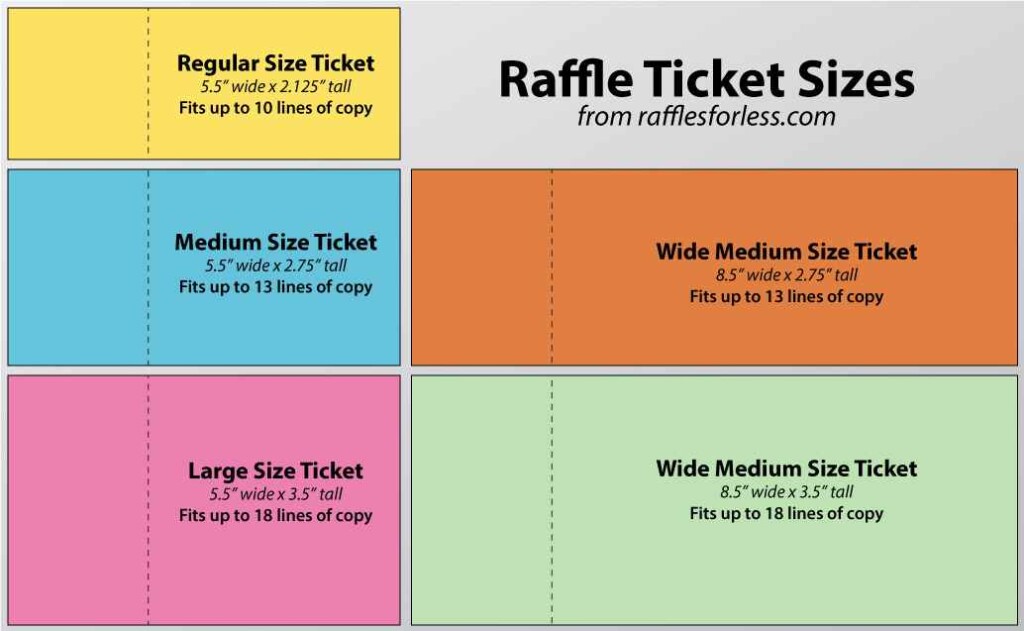
Raffles For Less currently offers regular, medium, large, wide medium, wide large, and calendar raffle formats.
| Ticket format | Best suited for |
| Regular | Simple raffles with limited information |
| Medium | More room for event and prize details |
| Large | Multiple details, larger prize information, or branding |
| Wide Medium | Events needing additional horizontal space |
| Wide Large | Detailed designs and more content |
| Calendar formats | Calendar-style fundraising raffles |
Before ordering, think about the information your ticket must contain.
If you need:
- A large prize description
- Sponsor logos
- Rules or disclosures
- Buyer information
- Multiple drawing details
- Additional event information
you may need more space.
Raffles For Less also provides ticket templates showing dimensions, safe areas, perforation locations, and numbering locations.
Mistake #3: Getting the Ticket Information Wrong
A beautifully designed ticket is still a problem if the information printed on it is incorrect.
Check every important detail before submitting your order.
At minimum, review:
- Organization name
- Event name
- Ticket price
- Prize description
- Drawing date
- Drawing time
- Drawing location
- Contact information
- Ticket number
- Buyer information fields
- Relevant terms or disclosures
- Permit or license information, if applicable
A single wrong date can make an entire print run difficult to use.
The same applies to prize descriptions. If your fundraiser advertises “$5,000 Cash Prize” but the ticket says “$500,” volunteers may have to explain the discrepancy repeatedly.
Use a Master Information Sheet
One practical way to prevent errors is to create a master document before designing your ticket.
Put the final approved information in one place and use that version for:
- The raffle ticket
- Flyers
- Social media
- Event pages
- Email promotions
- Volunteer instructions
- Prize signage
This reduces the chance that different versions of your event information will appear in different places.
Mistake #4: Treating Ticket Design as an Afterthought
Your raffle ticket is part of your fundraiser’s presentation.
That does not mean it needs to be elaborate. In fact, simple designs are often easier to understand.
The most effective tickets generally make the following information easy to find:
- Organization or event name
- Main prize
- Ticket price
- Drawing date
- Ticket number
- Buyer information
- Important rules or details
Avoid filling every available space.
Use readable fonts, sufficient contrast, clear spacing, and a logical hierarchy.
If you are designing artwork yourself, review the printer’s specifications before creating the final file. Raffles For Less specifically notes that its professional templates are intended as guides for print-ready artwork and show areas for sizing, perforation, and numbering.
You can also review custom raffle ticket design printing guidance before finalizing your artwork.
Avoid These Design Problems
- Tiny text
- Too many fonts
- Poor color contrast
- Crowded layouts
- Missing ticket numbers
- Unclear prize information
- Insufficient stub space
- Logos placed too close to the edge
- Information positioned over the perforation area
Good design is not about making the ticket flashy. It is about making the ticket easy to understand.
Mistake #5: Ignoring Numbering and Stub Requirements
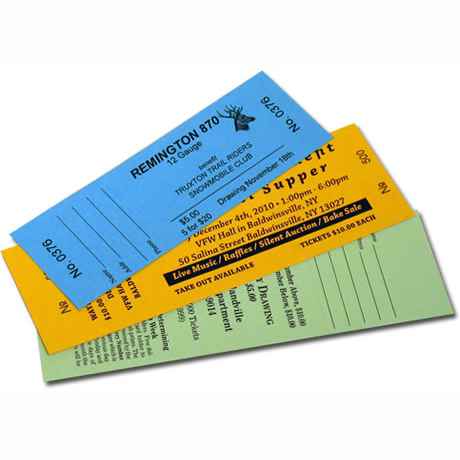
Numbering is one of the most important functional elements of a physical raffle ticket.
The participant’s ticket and the organizer’s stub should normally correspond.
For example:
Ticket: #01842
Stub: #01842
That matching number allows the organizer to identify the winning entry during the drawing.
Raffles For Less explains that unique and consecutive numbering can help organizers track tickets and conduct drawings more efficiently.
For a deeper explanation, see Purpose of the Numbers on Raffle Tickets
Keep Your Numbering System Organized
If volunteers receive different ticket ranges, maintain a simple record.
| Ticket range | Assigned to | Status |
| 0001–0050 | Volunteer A | Sold |
| 0051–0100 | Volunteer B | Sold |
| 0101–0150 | Volunteer C | Partially sold |
| 0151–0200 | Volunteer D | Returned |
This can make reconciliation much easier after ticket sales close.
For large quantities, avoid manually creating numbers unless you have a reliable process for preventing duplicates, gaps, or mismatches.
Mistake #6: Choosing the Cheapest Option Without Comparing Value
Saving money matters, especially for fundraisers.
But the lowest ticket price is not necessarily the lowest total cost.
A cheaper DIY approach can require:
- Paper
- Ink
- Cutting
- Perforating
- Numbering
- Assembly
- Volunteer labor
- Reprints
- Shipping or supply costs
Raffles For Less currently publishes pricing by ticket quantity and size, while noting that options such as two-sided printing, upgraded stock, gluing, and stapling can affect the final price.
Before deciding, compare the complete cost.
DIY Printing vs. Professional Printing
| Factor | DIY | Professional |
|---|---|---|
| Initial material cost | Can be low | Varies by order |
| Numbering | Usually organizer-managed | Professionally handled |
| Perforation | Requires equipment/process | Included depending on product |
| Cutting | Organizer responsibility | Completed during production |
| Labor | Higher volunteer time | Lower organizer workload |
| Consistency | Depends on equipment | More controlled |
| Large quantities | Can become time-consuming | Often more practical |
For a very small informal raffle, DIY may make sense.
For a larger fundraiser, professional production can save considerable preparation time.
Raffles For Less also offers professionally printed tickets that are consecutively numbered and perforated, with optional stapling or padding into books.
For more information, read How Bulk Raffle Ticket Printing Saves Money
Mistake #7: Skipping the Proof
This is one of the easiest raffle ticket mistakes to prevent.
Never assume that the design is correct just because you created it yourself.
Review the proof carefully before approving production.
Raffle Ticket Proof Checklist
Check:
- Organization name
- Spelling
- Prize amount
- Prize description
- Ticket price
- Drawing date
- Drawing time
- Contact information
- Ticket numbers
- Stub information
- Logo placement
- Colors
- Font size
- Perforation location
- Required rules or disclosures
- Overall dimensions
Then have someone else review it.
A second person is especially useful because the person who created the design may unconsciously read what they intended to write instead of what is actually printed.
Raffles For Less describes its ordering process as including a proof that customers can review before production.
Why Proofing Matters
Suppose you order 5,000 tickets and discover afterward that the drawing date is wrong.
You now have three choices:
- Use the incorrect tickets and create confusion.
- Explain the correction to every buyer.
- Pay for replacement tickets.
A few minutes of careful proofreading can prevent that entire problem.
Mistake #8: Ordering Too Few Tickets or Ordering Too Late
Timing is one of the most overlooked parts of ticket ordering.
Do not wait until the week of your fundraiser to think about printing.
You need enough time for:
- Finalizing the event details
- Designing the ticket
- Reviewing the proof
- Making corrections
- Production
- Shipping
- Distribution
- Volunteer preparation
Raffles For Less currently publishes a production schedule showing when orders placed by specific weekdays are expected to ship, with larger quantities potentially requiring additional production time.
The safest approach is to work backward from your first ticket-sale date.
Example Timeline
Fundraiser date: October 25
First ticket sales: September 1
Ticket distribution: August 25
Tickets should be received: August 20 or earlier
That gives you a buffer if something changes.
Do not plan around the absolute fastest possible delivery. A buffer gives you room to handle unexpected delays.
Mistake #9: Forgetting Raffle Rules and Legal Requirements
This is the mistake that deserves the most caution.
Raffle laws vary significantly by state and sometimes by local jurisdiction and organization type. Requirements can involve eligibility, permits, prize disclosures, ticket sales, drawing procedures, recordkeeping, and other conditions.
Do not assume that because a raffle is legal for one organization in one state, the same setup is automatically legal everywhere.
Before ordering, verify the rules that apply to your specific fundraiser.
Your local regulator, state gaming authority, state charity regulator, or qualified legal professional can help clarify requirements.
What About Federal Tax Rules?
Federal tax requirements are separate from state raffle legality.
The IRS treats raffle and charity drawing winnings as gambling winnings for certain federal reporting and withholding purposes. Current IRS instructions specifically address church raffles and charity drawings and explain when reporting and withholding requirements can apply.
For example, the IRS instructions explain that Form W-2G reporting rules can apply to qualifying raffle winnings, and the rules depend on the amount of winnings and the wager.
That does not mean every raffle organizer will have the same tax obligations. Review the current IRS guidance and obtain professional advice when necessary.
IRS Instructions for Forms W-2G and 5754
Important: Raffles For Less provides raffle ticket printing services, not legal or tax advice. Always verify the rules that apply to your particular event.
How to Do a Raffle Without Creating Ticket Problems
If you are wondering how to do a raffle, start with the operating plan before ordering the tickets.
Use this simple process:
Step 1: Define the Fundraiser
Determine the purpose, audience, fundraising target, prize structure, and drawing date.
Step 2: Verify Applicable Rules
Check state and local requirements before selling or printing tickets.
Step 3: Select Your Raffle Format
Decide whether you are running a traditional raffle, 50/50 raffle, basket raffle, calendar raffle, or another format.
Step 4: Decide What Information Belongs on the Ticket
Include the information participants and organizers actually need.
Step 5: Choose the Ticket Size
Match the size to the amount of information you need.
50/50 Raffle vs. Basket Raffle Tickets
Not every fundraiser uses tickets in exactly the same way.
A 50/50 raffle generally involves participants purchasing entries for a drawing in which the organization and winner split the proceeds according to the stated rules.
A basket raffle works differently. Participants may purchase tickets and place entries toward specific prizes or baskets.
The ticketing requirements can therefore differ.
What Is a 50/50 Raffle?
A 50/50 raffle is a fundraising drawing in which the prize is generally based on the money raised through ticket sales, with the winner receiving the stated share and the organization retaining the remainder.
For example, if $2,000 is collected and the stated rules provide for a 50/50 split, the winner would receive $1,000 and the organization would retain $1,000, subject to the rules governing the specific raffle.
Always verify that your proposed 50/50 format is permitted in your jurisdiction before selling tickets.
The IRS also specifically references a “50-50 drawing” in its Form W-2G instructions when discussing gambling-winnings reporting.
Basket Raffle Ideas
Basket raffles can be particularly effective when you have multiple donated items.
Instead of putting unrelated products together, build each basket around a theme.
Examples include:
- Movie night basket
- Family game night basket
- Coffee lover basket
- Spa and relaxation basket
- Grilling basket
- Sports fan basket
- Pet lover basket
- Local favorites basket
- Holiday basket
- Date night basket
- Gardening basket
- Beach vacation basket
These are useful fundraiser basket raffle ideas because the theme gives the prize a clear identity.
Ideas for Basket Raffle Themes
A good basket theme should make sense immediately.
For example:
Coffee Lover: Coffee, mugs, flavored syrups, cookies, and a gift card.
Family Game Night: Board games, snacks, cards, and a movie gift card.
Backyard BBQ: Grilling tools, sauces, seasonings, outdoor accessories, and a restaurant gift card.
Self-Care: Candles, bath products, skincare items, a soft blanket, and a spa gift card.
When looking for inexpensive raffle basket ideas, focus on presentation and theme rather than simply filling a basket with expensive products.
A thoughtfully assembled $75 basket can look more appealing than a random collection worth the same amount.
For additional prize inspiration, see 25 Cheap Raffle Prize Ideas
How to Choose the Best Raffle Prizes for a Fundraiser
The best items to raffle off for fundraiser events are not always the most expensive items.
The strongest prizes usually have one or more of these characteristics:
- Broad appeal
- Obvious value
- Easy-to-understand benefit
- Strong visual presentation
- Local relevance
- Donor or sponsor connection
- Seasonal appeal
- Practical usefulness
Gift cards, themed baskets, experiences, electronics, local business packages, family activities, and popular services can all work depending on the audience and rules.
Think about who is actually buying the tickets.
A prize that appeals strongly to parents may perform differently from one aimed at sports fans or corporate employees.
A Simple Prize Test
Before choosing a prize, ask:
Would someone who sees this prize immediately understand why it is worth entering the raffle?
If the answer is no, the prize may need better presentation or a stronger theme.
The prize should also match your ticket price.
A $1 ticket fundraiser may be structured differently from a raffle selling $25 entries. Your pricing, prize value, audience, and fundraising goal should work together.
For help with pricing, read How Much to Charge for Raffle Tickets
Raffle Ticket Best Practices
Use these practices before placing your order.
1. Start With the Event
Know how the raffle will operate before designing the ticket.
2. Keep the Ticket Easy to Read
Prioritize clarity over decoration.
3. Make the Prize Obvious
Do not hide the main reason people should participate.
4. Use Consistent Numbering
Matching and consecutive numbers make physical raffles easier to manage.
5. Give the Stub Enough Space
If volunteers need a name and phone number, make the fields practical to use.
Raffle Ticket Ordering Checklist
Before you click “order,” use this checklist.
- Raffle format is finalized
- Applicable state and local rules have been reviewed
- Prize information is final
- Ticket price is correct
- Drawing date is correct
- Drawing time is correct
- Drawing location is correct
- Organization name is spelled correctly
- Contact information is correct
- Ticket quantity has been calculated
- Ticket size has been selected
- Stub requirements are confirmed
- Numbering sequence is confirmed
- Buyer information fields are large enough
- Logo and branding are correct
- Artwork follows printer specifications
- Proof has been reviewed
- A second person has checked the proof
- Production time has been confirmed
- Shipping time has been considered
- Volunteers know how tickets will be distributed
- Ticket records are ready
For help with ticket formats and ordering, visit Raffles For Less Order Forms
You can also review before deciding on your quantity and ticket size. Raffle Ticket Pricing
Final Thoughts: Avoid Raffle Ticket Mistakes Before They Cost You
Most raffle ticket mistakes are not caused by complicated problems. They happen because an organizer is working quickly and overlooks one small detail.
The safest approach is to slow down before ordering.
Plan the raffle first. Choose a ticket format that fits the event. Make the information clear. Confirm your numbering. Review the printer’s specifications. Check applicable legal requirements. Proofread the final ticket with another person. Then allow enough time for production and delivery.
If you are running a 50/50 raffle, basket raffle, school fundraiser, charity drawing, church event, or community fundraiser, the same principle applies: your ticket should make the event easier to understand and easier to manage.
Raffles For Less offers multiple ticket sizes, paper colors, consecutive numbering, perforation, optional finishing, fast production options, and free shipping.
When you are ready to order, start with the Raffles For Less custom raffle ticket ordering options and build your ticket around the actual needs of your fundraiser. Raffles For Less
The goal is not simply to print tickets. It is to create a reliable, professional ticketing system that supports your fundraiser from the first sale to the final drawing.
Frequently Asked Questions About Raffle Ticket Mistakes
1. What are the most common raffle ticket mistakes?
The most common raffle ticket mistakes include choosing the wrong size, ordering too few tickets, entering incorrect information, using poor numbering, skipping proofing, overlooking applicable raffle rules, and waiting too long to order.
2. What information should be on a raffle ticket?
A raffle ticket commonly includes the organization name, raffle name, ticket number, ticket price, prize information, drawing date, drawing details, contact information, and a buyer-information stub when needed. Additional requirements can vary by jurisdiction and raffle type.
3. What is a 50/50 raffle?
A 50/50 raffle is a drawing where the winner receives the stated portion of the money raised and the organization retains the remaining portion. The exact structure and legality depend on the rules that apply to the fundraiser.
4. How do you number raffle tickets correctly?
Use a unique, consistent sequence and ensure that the main ticket and corresponding stub carry the same number. Maintain records of ticket ranges distributed to sellers and reconcile sold and returned tickets after the fundraiser.
5. How many raffle tickets should I order?
Order based on realistic expected sales rather than attendance alone. Consider your audience size, ticket price, selling period, previous fundraising results, and expected demand. A modest buffer can help prevent running out during the campaign.