The good news is that you can reduce your printing costs without sacrificing the features that matter most. Choosing the right quantity, ticket size, design, paper options and printing service can make a meaningful difference to your total cost.
This guide explains how to find affordable raffle ticket printing, what affects the price, when DIY printing makes sense, when professional printing is the better value, and how to avoid inexpensive choices that create bigger costs later.
What Is Cheap Raffle Ticket Printing?
Cheap raffle ticket printing means controlling unnecessary printing costs while keeping the features your fundraiser actually needs.
A low price should not automatically mean low quality. A well-planned ticket can use a simple design, standard dimensions and an appropriate quantity while still looking professional.
For most fundraisers, the best value comes from balancing:
| Factor | Budget-friendly approach | Why it matters |
| Quantity | Order the amount you realistically need | Larger runs can reduce unit cost |
| Design | Keep the layout clean | Avoid unnecessary design complexity |
| Size | Use a standard ticket size | Standard formats are usually more economical |
| Color | Use only what your design needs | Extra color can increase production cost |
| Numbering | Keep sequential numbering | Helps organize sales and drawings |
| Perforation | Keep the tear-off stub | Makes ticket handling easier |
| Shipping | Compare delivered cost | A low print price can be offset by shipping |
| Turnaround | Plan ahead | Avoid unnecessary rush charges |
The key distinction is simple: cheap should mean efficient, not poorly made.
What Actually Makes Raffle Tickets Cheap?
Several decisions affect the final price of printed tickets. Understanding them before ordering helps you spend money where it matters and avoid paying for features that do not benefit your event.
Quantity
Quantity is one of the biggest factors in cheap raffle tickets.
Printing a larger run can reduce the average cost of each ticket. However, ordering thousands more tickets than you can realistically sell is not automatically a smart saving.
Estimate your expected sales first.
For example, if your organization expects to sell about 1,800 tickets, compare the total cost of ordering 2,000 with ordering several smaller batches. Reordering later may cost more than planning a sensible initial quantity.
Design Complexity
A complicated design is not necessarily a better design.
A clean ticket with your organization name, raffle information, prize details, ticket number and contact information can look more professional than a crowded design filled with graphics.
For budget-conscious fundraisers, prioritize:
- Readable text
- Strong information hierarchy
- Your organization or event name
- Clear prize information
- Easy-to-find ticket numbers
- A clean tear-off stub
If you need design inspiration, reviewing real ticket examples can help you decide what information deserves space and what can be removed.
Ticket Size
Size affects both design space and cost.
A standard-size ticket may be enough for a school fundraiser or community raffle. A larger ticket can make sense when you need additional space for sponsors, multiple prizes, detailed instructions or branding.
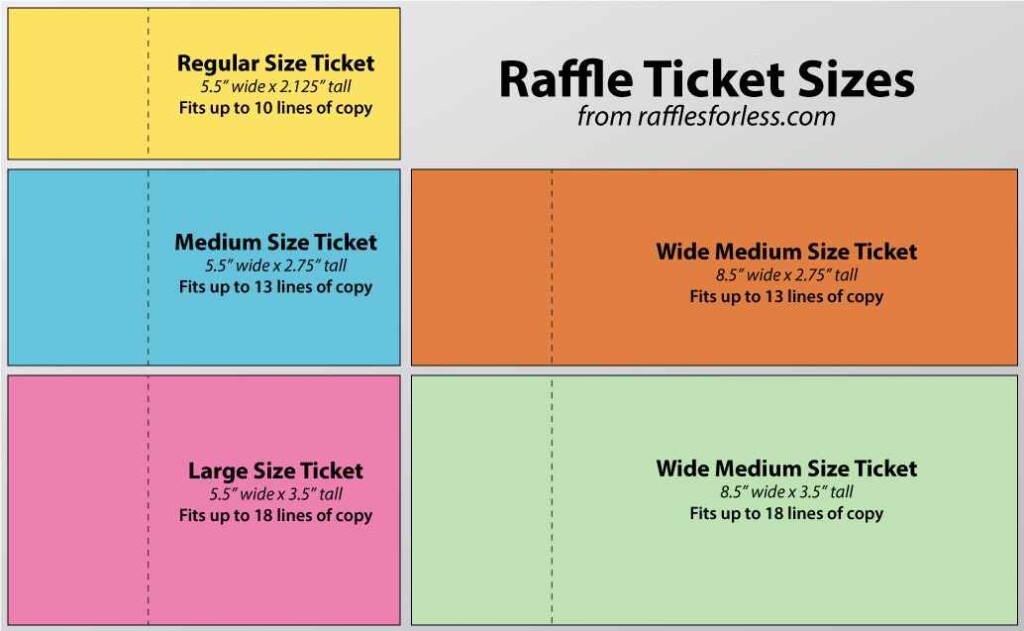
Raffles For Less currently offers regular, medium, large, wide medium and wide large ticket formats, along with calendar raffle options.
The best rule is to choose the smallest size that comfortably fits everything your ticket needs.
Color and Paper Choices
More customization is not always better.
If your organization has a strong brand color, one well-chosen color can provide plenty of visual identity without making the ticket unnecessarily complicated.
Likewise, standard paper options may be perfectly suitable for a fundraiser. Spend more only when a particular upgrade provides a genuine benefit.
How to Get Cheap Raffle Ticket Printing Without Losing Quality
The easiest way to lower your printing cost is to make several small, smart decisions rather than cutting one important feature.
1. Keep Your Ticket Design Simple
A clean layout saves space and makes the ticket easier to understand.
Your ticket should make the most important information obvious at a glance. Avoid filling every available area with graphics.
A useful design hierarchy is:
Event → Prize → Drawing information → Ticket number → Buyer information → Rules/contact details
Before approving your design, ask someone who was not involved in creating it to read the ticket. If they cannot quickly identify the event, prize and drawing information, simplify it.
2. Choose a Standard Ticket Size
Standard sizes are usually a practical choice when your priority is affordability.
A regular ticket can work well for straightforward raffles. Medium or large formats make more sense when you need additional copy.
Do not pay for a large ticket simply because it looks impressive. More space is valuable only when you actually need it.
3. Order a Sensible Quantity
One of the simplest ways to create budget raffle tickets is to avoid unnecessary small orders.
Suppose your fundraiser expects 3,000 sales. Ordering 500 tickets now and repeatedly placing additional orders could be less efficient than planning the full run in advance.
At the same time, avoid ordering 10,000 tickets simply because the unit price appears lower. Unsold tickets are not savings.
4. Compare the Total Delivered Cost
Do not compare printers using the ticket price alone.
Your real cost can include:
Printing + design fees + finishing + shipping + rush charges = total order cost
A printer offering a lower base price may become more expensive after additional charges.
Raffles For Less currently states that free shipping is available at checkout, which makes the delivered price easier to evaluate.
5. Plan Before Your Deadline
Last-minute orders create unnecessary pressure.
If you know your fundraiser date several weeks ahead, you have more time to compare options, check your design, approve a proof and select normal production and shipping.
Raffles For Less publishes a production schedule and states that orders of 5,000 tickets or fewer generally follow its standard schedule, with larger orders potentially requiring additional production time.
6. Use Design-It-Yourself Options When Appropriate
If you already know what your ticket should say, a self-service design option can reduce costs.
Raffles For Less says its Design It Yourself order forms offer its lowest pricing and allow customers to enter their information and view a proof before completing the order.
This can be particularly useful for organizations that need straightforward cheap raffle tickets without paying for unnecessary design assistance.
Cheap vs. Professional Raffle Ticket Printing
DIY printing can look inexpensive at first, but the real comparison is your total time, materials and result.
| Consideration | DIY Printing | Professional Printing |
| Upfront equipment | May require printer and supplies | No equipment required |
| Design control | High | High, depending on provider |
| Numbering | May require manual work | Can be professionally numbered |
| Perforation | Difficult without equipment | Designed for tear-off stubs |
| Large quantities | Time-consuming | Better suited to volume |
| Consistency | Depends on equipment | Consistent production |
| Volunteer time | Higher | Lower |
| Professional appearance | Depends on setup | Usually more consistent |
| Convenience | More work | Order and approve |
DIY printing can make sense for a very small event where you already have the equipment and only need a modest quantity.
Professional printing often becomes more attractive when you need hundreds or thousands of tickets, sequential numbering, perforated stubs or a consistent finished product.
The important point is that the cheapest printing method is not always the lowest-cost solution once your time is included.
How Much Does Raffle Ticket Printing Cost?
There is no single price for every order because ticket size, quantity, design and options affect the final total.
For example, Raffles For Less currently publishes different prices for five ticket sizes and quantities ranging from 250 upward. Its current price list shows a regular-size 250-ticket order at $33 and a regular-size 1,000-ticket order at $37, before any applicable additional options.
That illustrates why comparing cost per ticket can be more useful than looking only at the total order price.
For example:
| Order | Total price | Approx. cost per ticket |
| 250 tickets at $33 | $33 | $0.132 |
| 500 tickets at $35 | $35 | $0.070 |
| 1,000 tickets at $37 | $37 | $0.037 |
These figures are examples from the current Raffles For Less regular-size pricing page and are not universal industry prices. Options such as upgraded stock, two-sided printing, gluing or stapling can affect the final cost.
The lesson is more important than the numbers: compare the total price against the quantity you actually need.
Choosing the Right Raffle Ticket Size
The cheapest ticket is not necessarily the smallest ticket. It is the size that gives you enough room without paying for unnecessary space.
| Ticket Size | Dimensions | Good Choice For |
| Regular | 2-1/8 × 5-1/2 in. | Simple raffles |
| Medium | 2-3/4 × 5-1/2 in. | More information |
| Large | 3-1/2 × 5-1/2 in. | Multiple details or branding |
| Medium Wide | 2-3/4 × 8-1/2 in. | Wide layouts |
| Large Wide | 3-1/2 × 8-1/2 in. | Detailed designs |
Raffles For Less publishes these five standard formats and also offers calendar raffle formats.
For most straightforward fundraisers, start with the regular size. Move to a larger format only when your content requires it.
What Features Should You Never Sacrifice?
Saving money does not mean removing every useful feature.
Some ticket features can save time, reduce confusion and make your raffle easier to administer.
Sequential Numbering
Numbering helps you match the purchaser’s ticket with the organizer’s stub.
It can also help you track ticket distribution, identify winning tickets and reconcile unsold inventory.
Perforated Stubs
A perforated stub gives you a practical place to collect the buyer’s information while leaving the participant with a matching ticket.
For a traditional physical raffle, this is one of the features worth keeping.
Legible Printing
Never reduce print quality to the point where ticket numbers or important information are difficult to read.
A few dollars saved on production are not worthwhile if volunteers struggle to identify tickets or buyers question whether the ticket looks legitimate.
Accurate Proofing
Always review the final proof before production.
Check:
- Event name
- Date and time
- Drawing location
- Prize description
- Ticket price
- Contact information
- Ticket numbering
- Spelling
- Required rules or disclosures
A printing error can turn an inexpensive order into an expensive reprint.
Step-by-Step: How to Order Affordable Raffle Tickets
Step 1: Determine Your Quantity
Estimate how many tickets you expect to sell and add a reasonable buffer.
Do not automatically choose the largest quantity simply because it lowers the unit price.
Step 2: Choose Your Ticket Size
Start with a regular size if your information is limited. Choose a larger format when you need additional space.
Step 3: Write the Ticket Information
Prepare your event name, drawing date, prize information, ticket price, organization details and any required language before beginning the design.
Step 4: Choose a Simple Layout
Use readable fonts, clear spacing and a logical hierarchy.
Avoid unnecessary graphics that compete with the information buyers need.
Step 5: Review Pricing
Compare the total delivered cost rather than only the advertised base price.
Raffles For Less provides a current online price table and links directly to its order forms so customers can compare ticket sizes and quantities before ordering.
Step 6: Check the Proof Carefully
Do not rush this step.
Have another person review the proof if possible. A second set of eyes can catch a wrong date, misspelled name or incorrect number range.
Step 7: Approve and Order
Once every detail is correct, approve the proof and place the order early enough to accommodate your event schedule.
Common Mistakes That Make Cheap Tickets Expensive
Choosing the Absolute Lowest Price
The lowest quote may not include everything you need.
Compare numbering, perforation, design, shipping, turnaround and other options before deciding.
Ordering Too Few Tickets
Running out of tickets halfway through a campaign can force a second order when you could have planned the original quantity more efficiently.
Ordering Far Too Many
A lower per-ticket cost does not help if thousands of tickets remain unused.
Using an Overcrowded Design
More graphics do not automatically create a better ticket.
Clarity should come before decoration.
Skipping the Proof
This is one of the easiest ways to turn a low-cost order into a reprint expense.
Ignoring Legal Requirements
Raffle laws vary by state and locality. The IRS also treats raffles as gaming activities for certain federal tax and reporting purposes. Before selling tickets, verify the rules that apply to your organization and location.
Best Practices for Budget Raffle Tickets
If your goal is to keep your printing budget under control, use this approach:
- Decide your realistic ticket quantity.
- Choose the smallest suitable standard size.
- Keep the design clean.
- Keep sequential numbering.
- Keep the perforated stub.
- Compare the full delivered cost.
- Avoid unnecessary upgrades.
- Order before your deadline becomes urgent.
- Review every proof carefully.
- Confirm applicable raffle requirements before printing.
This approach gives you affordable tickets without turning “cheap” into “poor quality.”
Cheap Ticket Printing vs. Value-First Printing
There is an important difference between searching for the cheapest possible ticket and finding the best value.
Cheapest possible: Focuses almost entirely on the lowest initial price.
Value-first: Considers price, quality, convenience, features, shipping and reliability together.
For a fundraiser, value-first printing is usually the better strategy.
Your tickets represent your organization every time a supporter receives one. They do not need to be luxurious, but they should be clean, readable and functional.
Quick Checklist Before You Order
Use this checklist before approving your tickets:
- Correct organization/event name
- Correct drawing date
- Correct drawing time
- Correct location
- Correct ticket price
- Prize information is accurate
- Contact information is correct
- Ticket and stub numbers match
- Required rules or disclosures are included
- Text is easy to read
- Ticket size fits the content
- Quantity matches expected sales
- Shipping time fits your event date
- Final proof has been reviewed by another person
- Applicable state/local raffle requirements have been checked
Frequently Asked Questions
What is cheap raffle ticket printing?
Cheap raffle ticket printing means reducing unnecessary printing expenses while keeping the features needed for a professional, usable raffle ticket. The best approach is to control quantity, design complexity, size and optional upgrades rather than sacrificing readability, numbering or perforation.
How can I print cheap raffle tickets without losing quality?
Use a simple design, choose a standard size, order a sensible quantity, compare the total delivered cost and avoid unnecessary upgrades. Keep important features such as clear numbering, readable text and a practical tear-off stub.
Are cheap raffle tickets good enough for fundraisers?
Yes, if “cheap” means affordable rather than poorly made. A simple, professionally printed ticket can be inexpensive while still looking clean and trustworthy. Focus on the features that affect usability rather than paying for design elements your event does not need.
Is DIY or professional printing cheaper?
It depends on the size of your order and what equipment you already have. DIY printing can work for small quantities, but professional printing can provide better value for larger runs because numbering, perforation, consistency and production time are handled for you.
How can I save money on cheap raffle tickets printing?
Start by choosing the right quantity and standard size. Keep the design simple, avoid unnecessary finishing options, compare shipping costs and order before your deadline becomes urgent. Looking at the complete delivered price is more useful than comparing the base printing price alone.
What affects cheap ticket printing costs?
The main factors include ticket quantity, size, design complexity, paper or stock options, printing method, finishing, turnaround and shipping. Additional services can change the final price, so always compare the complete order cost.
Conclusion
Finding cheap raffle ticket printing is not about choosing the lowest number on a quote. It is about getting the right combination of price, quality and functionality for your fundraiser.
The biggest savings usually come from smart planning: choose a practical quantity, use a standard ticket size, simplify the design, compare the total delivered cost and avoid upgrades that do not add meaningful value.
At the same time, do not cut corners on the things that make a raffle easier to run. Clear printing, sequential numbering, perforated stubs and accurate information can save your organization time and prevent expensive mistakes.
For U.S. schools, churches, nonprofits, sports teams, charities and community organizations, a well-planned ticket can be affordable without looking cheap.
If you are ready to compare sizes and quantities, review current pricing and start your order, Raffles For Less provides online order forms and pricing designed to make the process straightforward.