If you need professional-looking tickets for a school fundraiser, nonprofit event, church raffle, sports fundraiser, charity event, or community drawing, custom printed raffle tickets give you more control over the design, information, numbering, and overall presentation. Instead of using a generic ticket, you can create a ticket that reflects your organization and gives participants the details they need.
The right custom raffle ticket should do more than look attractive. It should be easy to read, simple to distribute, properly numbered, practical for the drawing, and designed around the amount of information your event requires.
This guide explains how to choose the right size, what information to include, how professional printing works, how much tickets may cost, when DIY printing makes sense, and what to check before placing your order.
What Are Custom Printed Raffle Tickets?
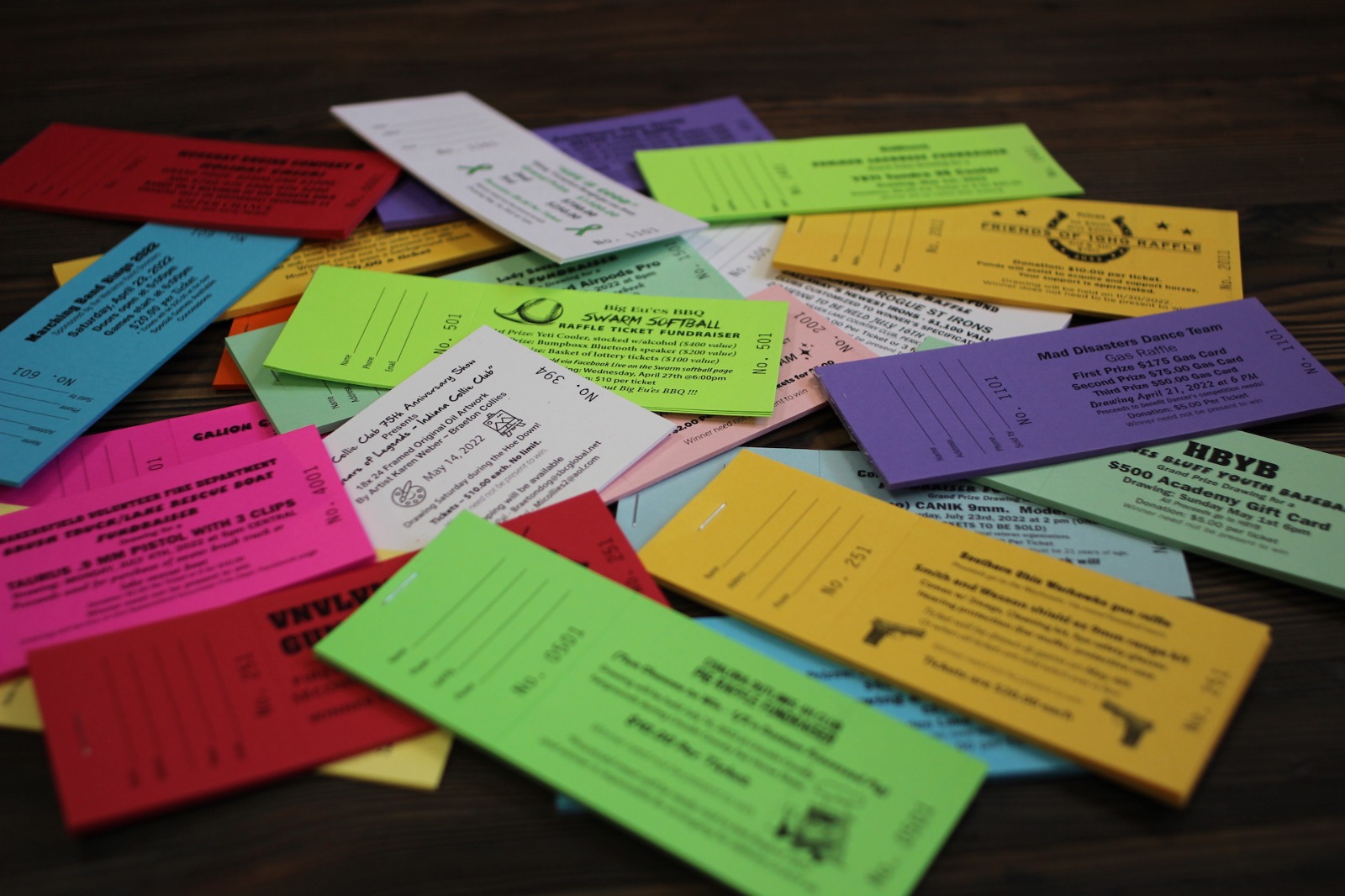
Custom printed raffle tickets are professionally produced tickets created specifically for an organization, fundraiser, event, or drawing. Unlike generic tickets, they can include your organization name, logo, event information, ticket price, prize details, drawing information, participant fields, and other relevant wording.
Most traditional raffle tickets also use a detachable stub and sequential numbering. The stub can be retained for the drawing while the participant keeps the main portion of the ticket.
Custom raffle tickets are professionally printed tickets personalized for a specific raffle or fundraiser. They can include an organization’s branding, event details, prize information, ticket numbers, pricing, contact information, and detachable stubs. Professional printing can also simplify numbering, perforation, cutting, and preparation for distribution.
Why Use Custom Raffle Tickets?
A raffle ticket is a small item, but it has several jobs to perform.
It needs to communicate the event clearly, provide a usable entry record, help organizers manage tickets, and give participants confidence that the fundraiser is organized.
1. They Create a Professional First Impression
Your ticket may be one of the first physical items a supporter receives from your organization.
A clean design with your logo, colors, event name, and prize information can make the fundraiser feel organized and intentional.
2. They Make Ticket Tracking Easier
Sequential numbering helps organizers identify individual entries and verify winning tickets.
A detachable stub can also provide a convenient place for a buyer’s name, phone number, or email address when that information is needed for the drawing.
3. They Give You More Design Control
With customized raffle tickets, you can choose the information and visual elements that matter to your event instead of trying to fit your fundraiser into a generic design.
Possible elements include:
- Organization logo
- Event name
- Ticket price
- Drawing date and time
- Prize information
- Organization contact information
- Participant information
- Sponsor information
- Applicable rules or required language
- QR code when appropriate
4. They Work for Different Types of Fundraisers
Custom tickets can be used for:
| Event Type | Useful Ticket Features |
| School fundraiser | School name, mascot, prize details, student information |
| Church fundraiser | Organization name, fundraiser purpose, drawing details |
| Sports fundraiser | Team branding, sponsor information, prize details |
| Charity event | Cause information, organization details, drawing rules |
| Community raffle | Event information, contact details, prize information |
| Corporate promotion | Company branding, promotional messaging, entry details |
What Should Go on a Custom Raffle Ticket?
Before beginning the design, make a complete list of the information your participants and organizers will need.
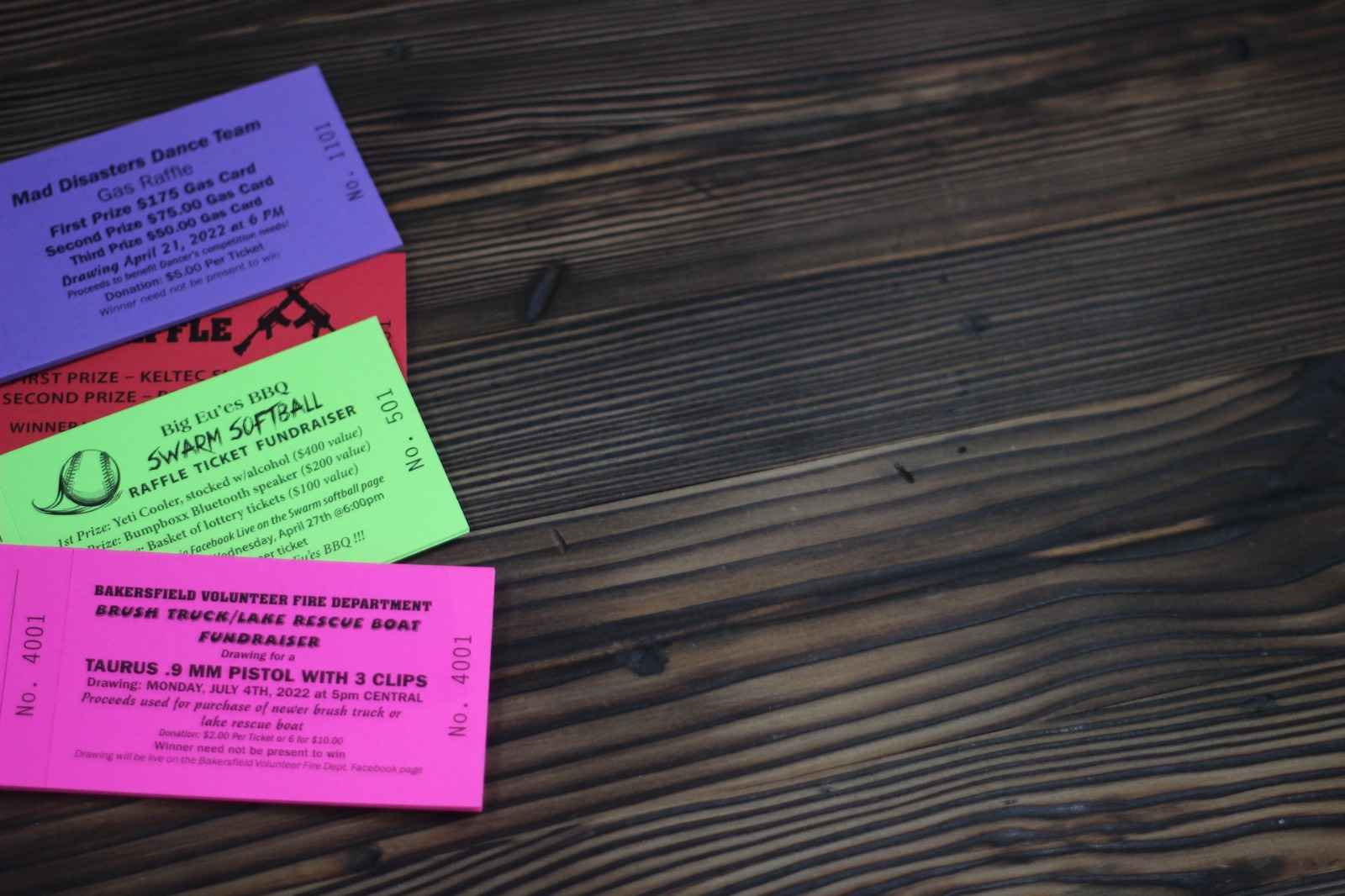
At minimum, consider including:
- Organization name
- Event or raffle name
- Ticket number
- Ticket price
- Prize information
- Drawing date
- Drawing time
- Drawing location, when applicable
- Contact information
- Required license or legal information, when applicable
The exact requirements can vary by state and raffle type, so organizations should confirm applicable rules before printing.
What Should Go on the Ticket Stub?
The stub should contain enough information to identify the entry after it is separated from the main ticket.
Common fields include:
- Matching ticket number
- Participant name
- Phone number
- Email address
- Other information required for your drawing
Avoid collecting personal information that your organization does not actually need.
For a more detailed content checklist, review our guide to what information to include on a raffle ticket before finalizing your artwork.
How to Choose the Right Raffle Ticket Size
Ticket size should be based primarily on the amount of information you need to print.
A small ticket is convenient and economical, but a larger ticket gives you more room for text, branding, sponsors, or additional details.
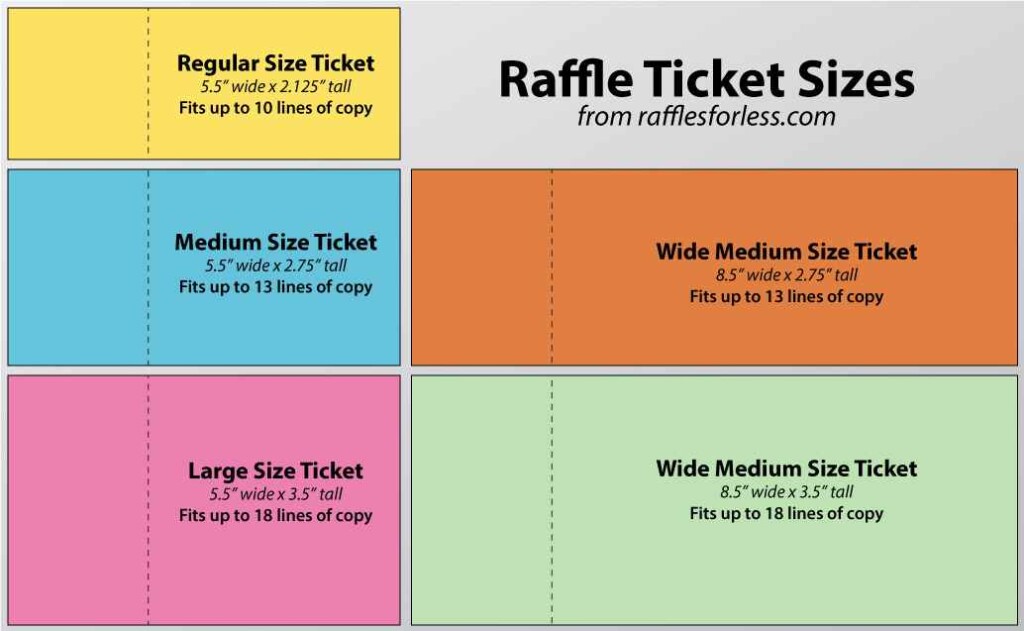
Raffles For Less currently offers five standard sizes:
| Ticket Size | Dimensions | Good For |
| Regular | 2-1/8″ × 5-1/2″ | Simple fundraisers |
| Medium | 2-3/4″ × 5-1/2″ | More information and branding |
| Large | 3-1/2″ × 5-1/2″ | Detailed ticket layouts |
| Medium Wide | 2-3/4″ × 8-1/2″ | Longer lines of information |
| Large Wide | 3-1/2″ × 8-1/2″ | Maximum design space |
Raffles For Less recommends using the amount of copy as a practical guide: regular tickets generally work with 10 lines or fewer, medium tickets with up to 13 lines, and large tickets with up to 18 lines. Wide formats are intended for layouts requiring more horizontal space.
Which Custom Raffle Ticket Size Should You Choose?
Use this simple rule:
Choose the smallest ticket that comfortably fits all essential information at a readable size.
Do not select a larger ticket simply because you have more design space. Extra space can be useful, but a clean layout is more important than filling every available area.
If you’re comparing dimensions, our raffle ticket size guide provides additional examples and planning tips.
Custom Raffle Ticket Printing Options
The right printing configuration depends on your event, quantity, design, and budget.
Sequential Numbering
Sequential numbering gives each ticket a unique identifier.
For example:
0001
0002
0003
0004
0005
Matching numbers on the ticket and stub make it easier to identify the winning entry.
Perforated Stubs
A perforated line separates the participant portion from the drawing stub.
This is useful when you need to:
- Collect entries
- Keep participant information
- Place entries into a drawing container
- Verify winning numbers
- Distribute tickets quickly
Paper Color
Raffles For Less currently offers 20 paper color choices, giving organizations additional flexibility for branding and event design.
Choose a color that maintains strong contrast with your printed text. A visually attractive ticket is not useful if important information becomes difficult to read.
One-Sided or Two-Sided Printing
One-sided printing works well when all essential information fits on the front.
Two-sided printing can provide additional space for:
- Rules
- Terms
- Sponsor information
- Organization information
- Instructions
- Additional promotional content
Stapling or Padding
Tickets can also be organized into books or groups when this fits the way your volunteers will distribute them.
Think about how tickets will actually be sold before choosing a finishing option.
Custom Printed Raffle Tickets vs. DIY Tickets
Both professional printing and DIY printing can work. The better option depends on the size and complexity of your fundraiser.
| Factor | Professional Printing | DIY Printing |
| Setup | Easier for larger orders | More hands-on |
| Numbering | Professionally handled | May require manual setup |
| Perforation | Ready-made | Requires equipment or perforated stock |
| Cutting | Professionally finished | Usually done manually |
| Design control | High | Very high |
| Labor | Lower | Higher |
| Large quantities | More practical | Can become time-consuming |
| Small quantities | Depends on budget | May be convenient |
When DIY Printing Makes Sense
DIY tickets can be practical when:
- You only need a small number.
- You already have suitable equipment.
- Your design is simple.
- You have enough time for cutting and organizing.
- You are comfortable managing numbering.
When Professional Printing Makes More Sense
Professional custom raffle ticket printing is worth considering when you need hundreds or thousands of tickets, consistent numbering, clean perforations, professional finishing, or a tight event deadline.
Raffles For Less also provides information for organizers who want to print tickets themselves, including guidance on paper, numbering, testing, cutting, and perforation.
How Much Do Custom Raffle Tickets Cost?
The cost of customized raffle tickets depends on several factors:
- Quantity
- Ticket size
- Printing method
- One-sided or two-sided printing
- Paper stock
- Finishing
- Design assistance
- Shipping
Raffles For Less publishes current pricing by quantity and ticket size. For example, its current pricing table covers multiple sizes and quantities and notes that options such as two-sided printing, upgraded stock, gluing, and stapling can affect the final price.
Is Ordering More Tickets Cheaper Per Ticket?
Often, larger quantities reduce the average cost per ticket because the production cost is spread across more tickets.
However, don’t order thousands simply because the unit price looks attractive.
Estimate realistic sales first and leave a reasonable margin for additional demand.
A Simple Quantity Planning Method
Start with:
Expected tickets sold + reasonable extra inventory = initial order quantity
For example, if you expect to sell 1,800 tickets, you might order somewhat more than 1,800 rather than ordering exactly the number you expect to sell.
The right amount depends on your distribution plan and whether reordering before the event would be practical.
How to Order Custom Raffle Tickets
A good ordering process starts before you open the order form.
Step 1: Determine Your Quantity
Estimate how many tickets you expect to sell.
Consider:
- Previous events
- Number of supporters
- Expected attendance
- Number of volunteers
- Selling period
- Prize appeal
Step 2: Select Your Ticket Size
Review your content and determine how much space you actually need.
Do not shrink the font simply to force too much information onto a small ticket.
Step 3: Prepare Your Information
Gather:
- Organization name
- Logo
- Event name
- Prize details
- Ticket price
- Drawing date and time
- Location
- Contact information
- Required legal or license information
Step 4: Choose Your Design Method
Depending on your needs, you can create your own artwork or use a design assistance option.
If you’re creating your own artwork, use the supplier’s template so the ticket dimensions, perforation area, and numbering position are correct. Raffles For Less provides templates showing the appropriate size, safe area, perforation location, and numbering position.
Step 5: Review the Proof
Never rush through the proofing stage.
Check every:
- Number
- Date
- Time
- Price
- Prize description
- Phone number
- Website
- Email address
- Logo
- Legal wording
- Spelling
A five-minute review can prevent an expensive reprint.
Step 6: Place Your Order
Once the design, quantity, size, and finishing options are confirmed, place the order and keep your order information available for reference.
Step 7: Plan Distribution
Before tickets arrive, decide:
- Who receives ticket books?
- How many tickets does each seller receive?
- How will money be collected?
- How will unsold tickets be returned?
- How will ticket numbers be tracked?
Good ticket design cannot compensate for a disorganized distribution process.
7 Design Tips for Better Custom Raffle Tickets
1. Put the Most Important Information First
Participants should quickly understand what the ticket is for.
Prioritize:
Event → Prize → Price → Drawing Details → Ticket Number
2. Make the Prize Easy to Find
If the prize is a major selling point, don’t bury it in small text.
Use hierarchy rather than excessive decoration.
3. Keep the Typography Readable
Avoid using several decorative fonts.
A simple combination of one strong heading font and one readable body font is usually enough.
4. Leave Enough Writing Space
If participants must provide their name or phone number, make sure there is enough room for handwriting.
5. Keep the Stub Functional
The stub is not just a smaller version of the ticket.
Design it around what the organizer actually needs during the drawing.
6. Use Branding Consistently
Your organization logo, colors, and event name should feel intentional rather than randomly placed.
7. Proofread With Fresh Eyes
Ask someone who did not create the artwork to review the final proof.
A second person may catch a date, number, spelling, or formatting problem that the original designer has overlooked.
Examples of Custom Raffle Ticket Layouts
School Fundraiser
Annual School Fundraiser
Grand Prize: $2,500
Ticket Price: $5
Drawing: October 25, 2026
Ticket No. 004281
Stub:
Name: __________
Phone: __________
Ticket No. 004281
Charity Event
Community Charity Raffle
Grand Prize: Weekend Getaway
$10 Per Ticket
Drawing: December 12, 2026
Organization Website
Ticket No. 015842
The back could include applicable rules and organization information.
Sports Team Fundraiser
2026 Baseball Team Raffle
Grand Prize: Sports Package
$5 Each or 5 for $20
Drawing Date: June 20, 2026
Team Name + Logo
Ticket No. 003615
The exact information and legal wording should always match the organization’s raffle requirements.
Common Mistakes to Avoid
Mistake 1: Choosing a Ticket That Is Too Small
Trying to fit 20 lines of information onto a small ticket usually creates tiny, difficult-to-read text.
Mistake 2: Forgetting the Drawing Details
Always verify the date, time, and location before approving the final proof.
Mistake 3: Making the Design Too Busy
Too many graphics, fonts, colors, and decorative elements can make important information harder to find.
Mistake 4: Ignoring the Stub
The stub needs to work for the people running the drawing, not just look attractive.
Mistake 5: Ordering Too Late
Production and shipping take time. If your event has a fixed date, build enough time into the schedule for proofing, production, delivery, and inspection.
For time-sensitive orders, Raffles For Less currently states that qualifying Design-It-Yourself black-print orders of 5,000 tickets or fewer placed by midnight EST Monday through Friday can ship the next business day. Larger, full-color, stapled, glued, or Design-It-For-Me orders may require additional production time.
Mistake 6: Forgetting Local Requirements
Raffle laws and requirements can vary by state and organization type. Check the rules that apply to your event before printing a large batch.
Custom Raffle Ticket Checklist
Use this checklist before approving your final design.
Event Details
- Organization name
- Event or raffle name
- Drawing date
- Drawing time
- Drawing location
- Prize details
- Ticket price
Ticket Design
- Logo
- Readable fonts
- Correct ticket size
- Correct perforation location
- Correct numbering location
- Matching ticket and stub numbers
- Adequate writing space
Compliance and Operations
- Required license information
- Applicable terms and conditions
- Contact information
- Participant information fields
- Distribution plan
- Ticket inventory plan
Final Proof
- Spelling checked
- Numbers checked
- Dates checked
- Phone number checked
- Website checked
- Prize information checked
- Someone else reviewed the proof
Frequently Asked Questions
What are custom printed raffle tickets?
Custom printed raffle tickets are professionally produced tickets designed specifically for a fundraiser, event, organization, or drawing. They can include custom branding, event information, prize details, ticket prices, sequential numbers, detachable stubs, and other information required for the event.
How do I make custom raffle tickets?
Start by determining your ticket quantity, size, event information, prize details, ticket price, drawing information, and required wording. Then create the artwork using an appropriate template or design service, review the proof, and submit the final order for printing.
What information should be on a custom raffle ticket?
A raffle ticket should generally include the organization name, event name, ticket number, price, prize information, drawing date and time, and contact information. Depending on the raffle, you may also need rules, license information, eligibility requirements, or other disclosures.
What size should a custom raffle ticket be?
The best size depends on how much information you need to print. Smaller tickets work well for simple fundraisers, while medium, large, and wide formats provide additional space for detailed information, branding, sponsors, or instructions.
Are custom raffle tickets numbered?
Professional raffle tickets commonly use sequential numbering. Matching numbers on the ticket and detachable stub can help organizers track entries and identify winning tickets.
Do custom raffle tickets have perforated stubs?
Many custom raffle tickets include perforated stubs. The stub can be separated from the participant portion and used for the drawing or for collecting participant contact information.
Conclusion
The best custom printed raffle tickets combine attractive design with practical event information. Your ticket should be easy to read, correctly numbered, simple to distribute, and large enough to hold the information participants actually need.
Before ordering, determine your quantity, choose the appropriate size, prepare your event details, decide whether you need a detachable stub, and carefully review the final proof.
For U.S. fundraisers, schools, nonprofits, churches, sports teams, charities, and community organizations, professionally printed tickets can save time while giving the fundraiser a polished, organized presentation.
If you’re ready to create custom raffle tickets, review available sizes, samples, pricing, and ordering options before submitting your final design.