If you are planning a school fundraiser, charity event, church raffle, sports fundraiser, community event, or nonprofit drawing, learning how to make raffle tickets can save time and help your event look more organized from the start.
The good news is that you do not need to be a professional graphic designer to create a functional raffle ticket. You need the right information, a practical layout, unique ticket numbers, a detachable stub when appropriate, and a design that is easy to read.
You also have a choice: make tickets yourself using professional design software, use a suitable template as a guide, or have professionally printed tickets produced for you.
This guide walks through the entire process, from planning and how to design a raffle ticket to numbering, printing, proofreading, and deciding when professional printing makes more sense.
What Is a Raffle Ticket?
A raffle ticket is a numbered entry used to participate in a random prize drawing. Traditional paper raffle tickets commonly have a main ticket section and a detachable stub.
The main portion can give the participant important event information, while the stub can be collected for the drawing and may contain the buyer’s name or contact information.
A good raffle ticket should do three things well:
- Identify the raffle and organization
- Give participants the information they need
- Make each entry easy to track and verify
For fundraising events, the ticket also represents your organization. A clean, professional ticket can make the entire fundraiser feel more organized and trustworthy.
How to Make Raffle Tickets: 8 Simple Steps
The easiest way to approach how to make raffle tickets is to separate the process into planning, design, numbering, proofing, and printing.
Step 1: Decide What Your Raffle Is About
Before opening a design program, gather the basic information.
Write down:
- Organization or fundraiser name
- Event name
- Prize or prizes
- Ticket price
- Drawing date
- Drawing time
- Drawing location
- Contact information
- Ticket eligibility requirements
- Winner notification instructions
- Any required legal information
Doing this first prevents you from designing the ticket and then discovering that important information is missing.
Step 2: Choose Your Ticket Size
Ticket size affects how much information you can comfortably include.
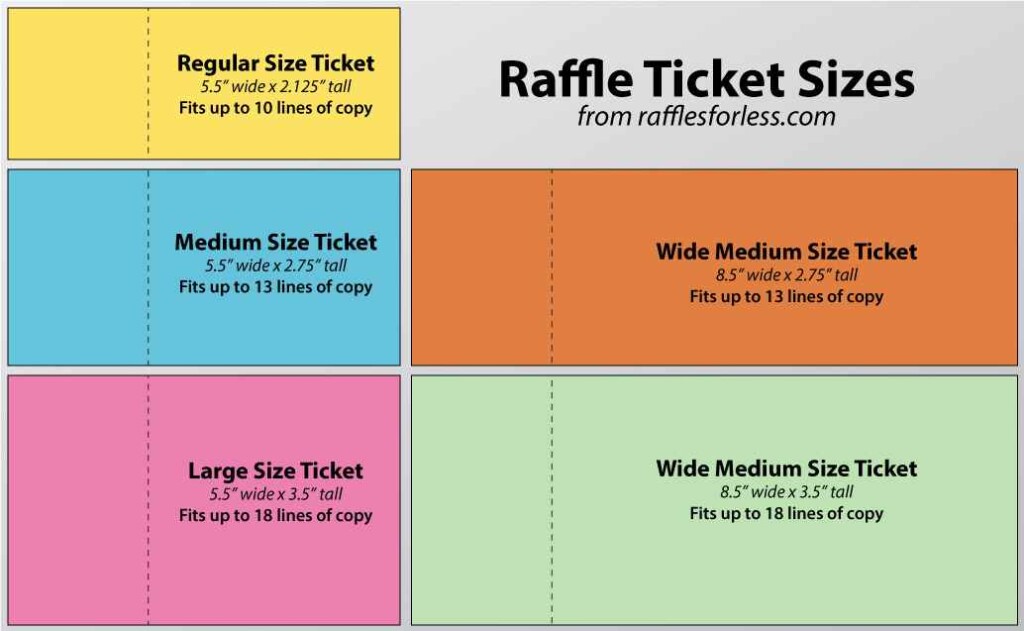
Raffles For Less currently offers several standard ticket sizes, including regular, medium, large, wide medium, and wide large formats. It also offers calendar raffle sizes.
For example:
| Ticket size | Overall dimensions | Good for |
| Regular | 5.5 × 2.125 inches | Simple fundraisers |
| Medium | 5.5 × 2.75 inches | More event information |
| Large | 5.5 × 3.5 inches | Larger prizes and more copy |
| Wide Medium | 8.5 × 2.75 inches | Extra horizontal space |
| Wide Large | 8.5 × 3.5 inches | Detailed designs |
| Small Calendar | 5.5 × 4.25 inches | Calendar raffles |
| Large Calendar | 8.5 × 5.5 inches | Larger calendar raffles |
Before designing, check the exact specifications of the printer you plan to use.
If you want to compare available formats, review Raffles For Less’s raffle ticket sizes and order options before building your artwork.
Step 3: Plan the Ticket and Stub
Traditional raffle tickets normally have two functional areas:
Ticket: The portion retained by the buyer.
Stub: The portion collected by the organizer for the drawing.
The two sections should have matching numbers.
For example:
Ticket: #01842
Stub: #01842
If you collect buyer information, leave enough room for the information you actually need. Do not make the writing area so small that volunteers or participants cannot use it comfortably.
Step 4: Add the Essential Information
A professional ticket should communicate the important details quickly.
At minimum, consider including:
- Organization name
- Raffle/event name
- Ticket number
- Ticket price
- Prize information
- Drawing date
- Drawing time
- Drawing location, if applicable
- Contact information
- Terms and conditions
- Required disclosures or permit information
- Buyer information area, when needed
For a more detailed breakdown, see our guide to what information to include on a raffle ticket.
The exact legal information required can vary by location, so do not assume that one ticket format works for every U.S. state.
Step 5: Create a Clear Visual Hierarchy
Now you can focus on how to design a raffle ticket that people can understand at a glance.
A simple hierarchy works well:
- Raffle or event name
- Prize
- Ticket price
- Drawing date
- Organization information
- Rules and additional details
The most important information should be visually stronger than the supporting text.
For example, if the grand prize is a $5,000 cash prize, do not bury it in tiny text near the bottom of the ticket.
Step 6: Add Your Branding
Your raffle ticket should look like it belongs to your organization.
Consider adding:
- Logo
- Brand colors
- Organization name
- Event theme
- Sponsor logos
- Website
- Social media information
Use branding to make the ticket recognizable without making it visually crowded.
Two or three complementary colors are generally easier to read than a design containing many competing colors.
Step 7: Add Sequential Numbers
Numbering is one of the most important functional elements of a traditional raffle ticket.
Each ticket should have a unique number, and the matching stub should carry the same number.
A sequence might look like:
- 00001
- 00002
- 00003
- 00004
- 00005
Keep a record of the number range you receive and distribute.
If you are ordering professionally printed tickets, confirm how numbering is handled before placing the order.
Step 8: Proof Everything Before Printing
Never rush directly from design to production.
Check:
- Spelling
- Prize amount
- Ticket price
- Drawing date
- Drawing time
- Contact information
- Organization name
- Ticket numbers
- Terms and conditions
- Stub information
- Logo quality
- Font sizes
- Perforation placement
- Overall alignment
A five-minute proofread can prevent hundreds or thousands of incorrectly printed tickets.
What Information Should Go on a Raffle Ticket?
One of the most common mistakes when people create raffle tickets is trying to make the ticket attractive without making it useful.
A good ticket balances design and information.
Essential Information
| Information | Why it matters |
| Organization name | Identifies the raffle sponsor |
| Event name | Tells buyers what they entered |
| Ticket number | Identifies the entry |
| Ticket price | Makes the purchase terms clear |
| Prize information | Explains what participants can win |
| Drawing date | Tells participants when the winner will be selected |
| Drawing time | Removes uncertainty |
| Contact information | Helps participants reach the organizer |
| Rules/terms | Communicates important conditions |
| Buyer information | Helps identify winners when required |
Some raffles may require additional information under state or local rules.
The National Council of Nonprofits notes that raffle and other games-of-chance requirements vary significantly by state, and some states require licenses or other compliance steps.
That means your ticket design should be finalized only after you understand the rules that apply to your particular raffle.
How to Design Raffle Tickets That Look Professional
When you design raffle tickets, focus on clarity before decoration.
Make the Prize Easy to See
The prize is often one of the strongest reasons someone decides to purchase a ticket.
If your prize is attractive, give it visual prominence.
Instead of:
GRAND PRIZE
One winner will receive a prize.
Use something more direct:
WIN $2,500 CASH
The second version communicates the value immediately.
Use Readable Fonts
Avoid using decorative fonts for every part of the ticket.
A practical combination is:
- Bold font for the headline
- Strong display font for the prize
- Simple font for supporting information
Remember that raffle tickets can be handled in busy environments, so readability matters.
Leave Enough White Space
Do not fill every available inch.
White space helps separate:
- Prize information
- Ticket price
- Drawing information
- Rules
- Contact details
A ticket with less information can actually communicate more effectively when the information is organized properly.
Keep the Stub Functional
The stub should have enough space for the information you need to collect.
If you require a name and phone number, design the stub around those fields rather than trying to squeeze them into a tiny corner.
Make the Number Easy to Find
A ticket number should be immediately recognizable.
Use a consistent location and adequate contrast.
This becomes especially important when volunteers are checking hundreds or thousands of tickets.
Raffle Ticket Samples and Design Ideas
Looking at real raffle ticket samples is useful before you begin designing.
Instead of copying another organization’s design, look for patterns that work:
- Clear prize placement
- Strong organization branding
- Easy-to-read ticket numbers
- Simple color combinations
- Clearly separated stub
- Logical information hierarchy
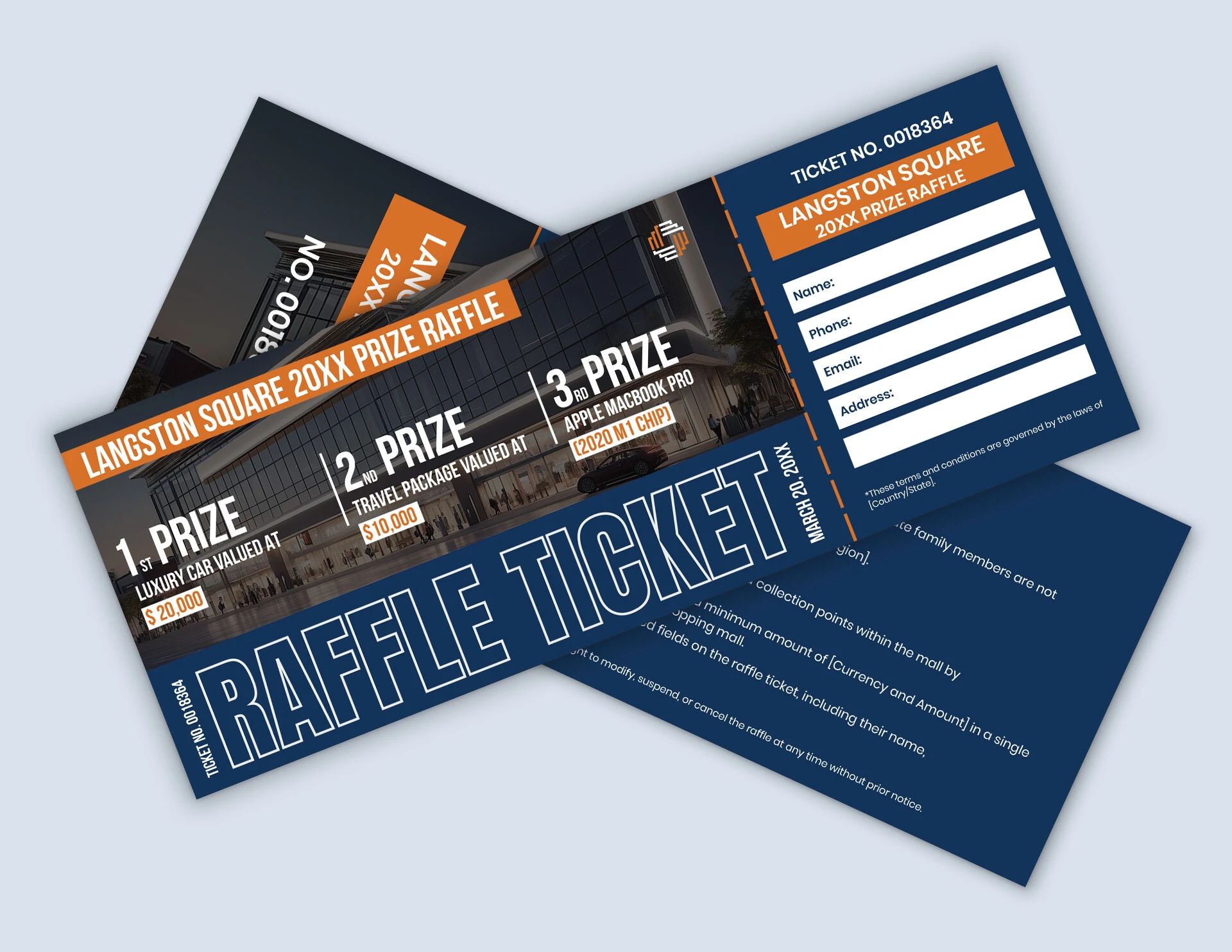
Raffles For Less has a dedicated raffle ticket samples gallery showing different sizes and Design-It-Yourself and professionally designed examples.
Sample of Raffle Ticket Design
Here is a simple example of how the information can be organized:
ANNUAL COMMUNITY FUNDRAISER
GRAND PRIZE: $2,500 CASH
Ticket Price: $10
Drawing Date: October 25, 2026
Drawing Time: 7:00 PM
Location: Community Center
Ticket No. 01842
STUB
Ticket No. 01842
Name: ______________________
Phone: _____________________
Additional raffle rules and eligibility information can appear below the main ticket information or on the reverse side when the format permits.
This is only a content example. Your final layout should follow the specifications of the printer you choose.
Four Ways to Create a Raffle Ticket
There is no single method that works for every fundraiser.
| Method | Cost | Design control | Best for |
| Professional design software | Low software cost if already owned | High | Experienced designers |
| Template-based design | Low | Medium to high | Organizers who need a starting point |
| DIY home printing | Low initial cost | Medium | Small informal events |
| Professional printing | Varies by quantity/options | High | Fundraisers needing consistent quality |
Option 1: Professional Design Software
Experienced designers can build artwork using programs such as Adobe Illustrator or InDesign.
This provides maximum control over:
- Typography
- Images
- Branding
- Layout
- Color
- Print-ready files
Raffles For Less provides graphics templates showing ticket dimensions, safe areas, perforation locations, and numbering locations. The company specifically states that these templates are intended as guides for professional design software rather than simple editing in Word or PowerPoint.
Option 2: Use a Raffle Ticket Template
A template can give you a starting structure.
However, not every free template is suitable for professional printing.
Before choosing one, check:
- Finished dimensions
- Safe area
- Bleed requirements
- Stub location
- Numbering location
- Printing requirements
- File format
For professional printing, use the printer’s own specifications rather than assuming an internet template will fit.
Option 3: Make Tickets at Home
DIY printing can work for a small event where the organizer has the right equipment and enough time.
You will need to manage:
- Paper
- Layout
- Numbering
- Cutting or perforating
- Ink
- Alignment
- Quality control
The apparent savings can disappear if you need to buy supplies, replace printer cartridges, or spend hours preparing hundreds of tickets.
Option 4: Order Professionally Printed Tickets
Professional printing is often the simplest option for larger fundraisers.
Raffles For Less offers professionally printed, consecutively numbered and perforated raffle tickets in multiple sizes and paper colors, with optional stapling or padding into books.
The company also offers a Design-It-Yourself process where customers can enter their information, choose design options, view a proof, and place the order online.
DIY vs. Professional Raffle Tickets
Which option is better depends on your event.
| Consideration | DIY | Professional |
|---|---|---|
| Upfront cost | Usually lower | Depends on quantity/options |
| Setup time | Higher | Lower |
| Design control | High | High |
| Numbering | Organizer-managed | Professionally handled |
| Perforation | More work | Built in |
| Consistency | Depends on equipment | Consistent |
| Large quantities | Time-consuming | Easier |
| Professional appearance | Depends on execution | More predictable |
DIY Printing Pros
- More control
- Useful for very small quantities
- Can be completed with equipment you already own
- Easy to make last-minute changes
DIY Printing Cons
- Numbering can become complicated
- Cutting takes time
- Alignment can be inconsistent
- Paper and ink costs add up
- Professional perforation can be difficult
Professional Printing Pros
- Consistent sizing
- Professional perforations
- Sequential numbering
- Less volunteer preparation
- Better consistency across large quantities
Professional Printing Cons
- Requires advance planning
- You need to approve the design before production
- Some customization options increase the price
How to Number Raffle Tickets Correctly
When making raffle tickets, numbering deserves as much attention as the visual design.
Use a numbering system that is:
- Unique
- Easy to read
- Consistent
- Trackable
- Matched between ticket and stub
For example:
Ticket: 1001
Stub: 1001
Then:
Ticket: 1002
Stub: 1002
Do not accidentally create two tickets with the same number.
For large events, maintain a simple tracking sheet showing:
| Number range | Assigned to | Sold/returned |
| 1001–1050 | Volunteer A | Sold |
| 1051–1100 | Volunteer B | Sold |
| 1101–1150 | Volunteer C | Returned |
This makes it easier to reconcile tickets after sales close.
Raffle Ticket Sizes: How Much Space Do You Need?
Your ticket size should match the amount of information you need.
A simple school fundraiser might work well with a regular-size ticket.
A ticket containing:
- Multiple prizes
- Sponsor information
- Detailed rules
- Buyer information
- Additional event details
may benefit from a larger format.
Raffles For Less currently lists regular, medium, large, wide medium, and wide large options, as well as calendar raffle formats.
Before choosing a size, ask:
- How much information must be printed?
- Does the stub need buyer information?
- Will the ticket be kept as a receipt?
- Does the design need sponsor logos?
- Does the printer have specific layout requirements?
Common Raffle Ticket Design Mistakes
1. Making the Ticket Too Crowded
Trying to include every detail can make the ticket difficult to read.
Fix: Separate essential information from secondary information.
2. Using Tiny Text
Small text may look acceptable on your computer but become difficult to read on an actual printed ticket.
Fix: Print a test proof at the intended size.
3. Forgetting Matching Numbers
A ticket and stub with different numbers can create confusion during the drawing.
Fix: Verify the numbering system before production.
4. Ignoring the Perforation
If you are using a traditional stub ticket, the perforation needs to be positioned correctly.
Fix: Follow your printer’s exact template and specifications.
5. Designing for the Wrong Size
A design created for one ticket format may not fit another.
Fix: Start with the exact template or order form for your selected size.
6. Forgetting Legal Requirements
Raffle regulations differ throughout the United States.
Fix: Confirm state and local requirements before printing.
7. Skipping the Proof
One wrong date or prize amount can make an entire print run unusable.
Fix: Review every detail before approving production.
Raffle Ticket Design Best Practices
If you want your ticket to look professional and work smoothly, follow these principles:
Keep the Main Message Obvious
A person should understand what the ticket is for within seconds.
Make the Prize Stand Out
The prize should be one of the first things a buyer notices.
Use Consistent Branding
Match your logo, colors, and typography with your organization.
Make Important Details Scannable
Use headings, bold text, spacing, and clear sections.
Design Around the Stub
Do not treat the stub as an afterthought.
Keep Numbering Consistent
Use a logical sequence and maintain a sales record.
Proof at Actual Size
Always check the ticket at the size people will actually receive.
Order Extra When Appropriate
Running out of tickets before the fundraiser ends can be more disruptive than having a modest number left over.
How Much Does It Cost to Make Raffle Tickets?
The cost depends on quantity, ticket size, printing, paper, design, and finishing options.
For example, Raffles For Less currently lists Design-It-Yourself pricing by quantity and size. Its published price table includes quantities from 250 upward, with options that vary by ticket format. Additional options such as two-sided printing, upgraded stock, gluing, and stapling can affect the final price.
That means the cheapest-looking option is not always the best value.
Compare the total cost of:
- Design
- Paper
- Ink
- Numbering
- Perforation
- Cutting
- Labor
- Shipping
- Finishing
For a larger fundraiser, professional production may save substantial volunteer time even when DIY printing has a lower initial price.
How to Choose Between a Template and Custom Design
Choose a template when:
- Your event is straightforward
- You want to design the ticket yourself
- You have limited design experience
- You can follow the printer’s specifications
Choose custom design support when:
- Your ticket has extensive information
- You need a polished branded design
- You are working with sponsors
- You are ordering a large quantity
- You are not comfortable preparing print-ready artwork
Raffles For Less offers both Design-It-Yourself and Design-It-For-Me options, giving organizers a choice between controlling the layout themselves and having a designer create it.
U.S. Raffle Rules: Check Before You Print
A raffle ticket is a printed item, but the raffle itself can involve legal and tax considerations.
Raffle rules are not uniform across the United States. State and local requirements can determine who may conduct a raffle, whether registration or licensing is required, what information must appear on tickets, and whether online sales are permitted. The National Council of Nonprofits specifically advises organizations to understand the rules applicable to their state before conducting games of chance.
Federal tax rules can also apply to raffle winnings. The IRS treats lottery and raffle winnings as gambling winnings, including the fair market value of noncash prizes.
Before printing, verify:
- Who is legally permitted to conduct the raffle
- Whether a permit or registration is required
- Ticket disclosure requirements
- Eligibility restrictions
- Drawing requirements
- Prize rules
- Recordkeeping requirements
- Tax reporting or withholding obligations
This article provides general information, not legal or tax advice. If you are unsure about your state’s requirements, consult the appropriate state agency or qualified professional.
Raffle Ticket Creation Checklist
Use this checklist before sending your tickets to print:
- Confirm your raffle is permitted in your jurisdiction
- Confirm any required registration or permit
- Choose the ticket size
- Select a template or layout
- Add your organization name
- Add the event name
- Add the ticket price
- Add prize information
- Add drawing date and time
- Add location when applicable
- Add contact information
- Add required rules or disclosures
- Create the ticket and stub layout
- Add matching ticket numbers
- Check the perforation location
- Proofread every word
- Verify all dates and prices
- Review the ticket at actual size
- Confirm quantity
- Approve the final proof
- Keep a record of the ticket number range
Frequently Asked Questions About Making Raffle Tickets
How do I make raffle tickets at home?
You can make raffle tickets at home by creating a properly sized layout, adding the required information, assigning unique numbers, printing on suitable stock, and cutting or perforating the tickets. For larger quantities, professional printing can reduce the time and consistency problems associated with DIY production.
What should a raffle ticket look like?
A raffle ticket should have a clear event or organization name, ticket number, price, prize information, drawing details, and relevant rules or contact information. Traditional tickets also include a detachable stub with a matching number and, when needed, space for participant information.
What is the best size for a raffle ticket?
There is no single best size for every raffle. Smaller tickets work well for simple events, while larger formats provide more space for prizes, rules, sponsor information, and participant details. Choose a size based on the amount of information and the printer specifications.
How do you design a raffle ticket?
To design a raffle ticket, start with the exact print dimensions, plan the ticket and stub, add essential event information, create a clear visual hierarchy, include your branding, assign matching numbers, and proof the finished design at actual size.
Can I create raffle tickets in Word?
You can create a basic ticket layout in Word, but the software may not be suitable for preparing professional print-ready raffle artwork. If you are using a professional printer, follow that printer’s templates and artwork requirements instead of assuming a Word document will align correctly.
Conclusion: Make Raffle Tickets That Are Easy to Read and Manage
Learning how to make raffle tickets is not simply about putting a logo and number on a piece of paper. The best tickets combine clear information, practical numbering, readable design, a functional stub, appropriate sizing, and careful proofing.
For a small fundraiser, DIY raffle ticket methods may be enough. For larger events, professionally printed tickets can save time and provide more consistent numbering, perforation, and production quality.
Before you print, review your local requirements, finalize the ticket information, check your design at actual size, and verify every number and date.
If you are ready to move from design to production, Raffles For Less offers multiple ticket sizes, Design-It-Yourself options, professional design support, consecutive numbering, perforation, and finishing options.
The goal is simple: create a ticket that looks professional, gives participants the information they need, and makes your raffle easier to manage from the first sale through the final drawing.