People decide whether to buy a raffle ticket in a few seconds, and your raffle ticket design does most of the talking. In that moment, the ticket has to answer four questions: What can I win? What does it cost? Who is this for? Can I trust these people? Answer all four clearly, and the ticket nearly sells itself. Leave one unanswered and even a great prize sits in the cash box.
This guide covers exactly how to design a raffle ticket that sells, from layout and paper color to stubs, numbering, and print setup. Raffles For Less prints millions of raffle tickets every year, so the advice here is grounded in real print limits, not just what looks good on a screen. If you’re a first-time organizer, you’ll get a clear path. If you’ve run a dozen raffles, you’ll find a few details worth double-checking.
What makes a good raffle ticket design?
A good raffle ticket design leads with the prize, shows the price and drawing date, keeps text large and uncluttered, and includes a numbered stub for the buyer’s contact details. Use high-contrast colors, stay inside the printer’s safe area, and proofread every word before you order.
What Is Raffle Ticket Design, and Why Does It Affect Sales?
Raffle ticket design is the layout, wording, colors, and numbering that make up a printed raffle ticket. It covers everything a buyer sees, including the prize, price, drawing date, and organizer, plus the tear-off stub used for the drawing. Good design makes a ticket easy to read, easy to trust, and easy to buy.
A ticket does three jobs at once. It’s a small advertisement for your prize, a receipt for the buyer, and a record for you. When the layout is cluttered or confusing, all three jobs suffer. Buyers hesitate, volunteers answer the same questions all night, and the drawing gets messier than it needs to be.
To be straight with you, design won’t rescue a weak prize or a raffle nobody knows about. What it does is remove friction at the exact moment someone decides whether to reach for their wallet.
The Anatomy of a Raffle Ticket
Every ticket we print has two parts joined by a perforation. On our standard layouts, the perforation sits 2 inches from the left edge, which makes the left side the stub and the rest the ticket body. Each ticket is numbered consecutively, and the number prints in a fixed spot, so your artwork has to leave room for it.
Raffle Ticket Design Basics for the Ticket Body
The body is your sales pitch. It should carry:
- The prize (or top prizes) and its value, if you can share it
- The ticket price and any bundle deal
- Your organization’s name and logo
- The drawing date, time, and location
- A short line on where the money goes
- A phone number, website, or email for questions
- Any wording your state requires, such as a license number
What Goes on the Stub
The stub is what you collect for the drawing, so it needs room for the buyer’s name, phone number, and email. Make those lines long enough to write on without squeezing, and keep decorative artwork out of the writing area.
what should be on a raffle ticket?
A raffle ticket should show the prize, ticket price, drawing date and location, organizer name, and a unique ticket number that matches the stub. Add contact information, a short note about where proceeds go, and any license number or legal wording your state requires.
11 Raffle Ticket Design Tips That Actually Sell Tickets
These tips are ordered roughly by impact. If you only have ten minutes, do the first four.
1. Lead With the Prize, Not Your Organization
Buyers are paying for a chance at something, so put the prize in your biggest type. ‘Win a $500 Gift Card’ beats ‘Annual Spring Fundraiser Raffle’ every time. Be specific. Name the item or the dollar value. If you have several prizes, feature the top two or three and add a line like ‘plus 7 more prizes.’
2. Make the Price and Bundle Deal Easy to Spot
Put the price right next to the prize in plain text, such as ‘$5 each or 5 for $20.’ A bundle gives buyers an easy reason to take more than one. If you’re still deciding on numbers, our guide on how much to charge for raffle tickets walks through it.
3. Spell Out the Drawing Details
Include the date, time, and place of the drawing, how winners will be contacted, and ‘Winner need not be present’ if that’s true. Unanswered questions stall sales, because people won’t buy until they know when and how the winner is chosen.
4. Match Your Copy to the Ticket Size
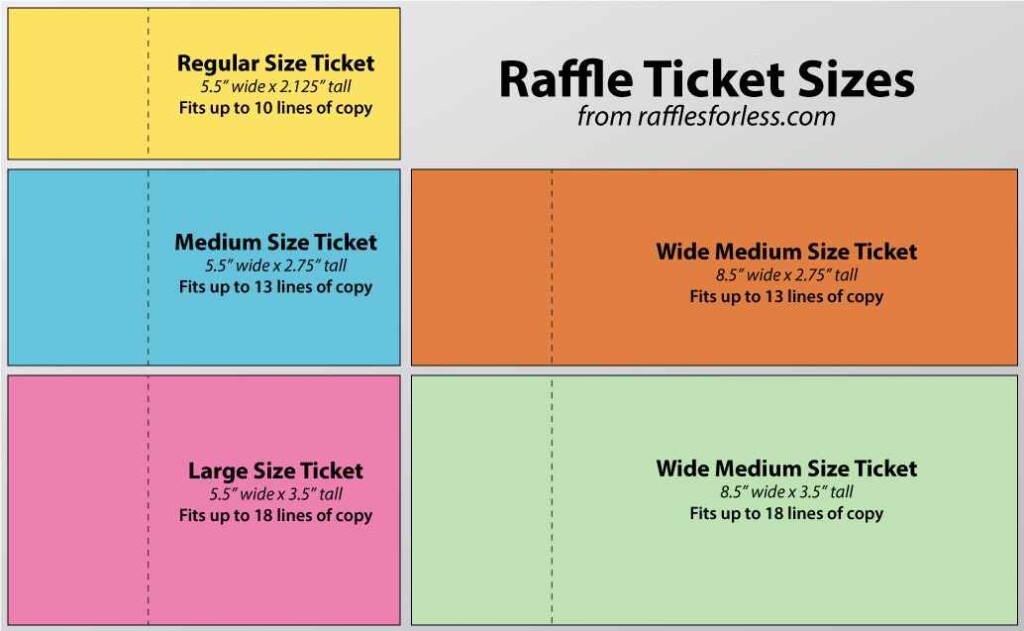
Every size has a limit on how much text fits. Regular tickets hold up to 10 lines of copy, medium and wide medium hold 13, and large and wide large hold 18. If your wording doesn’t fit, don’t shrink the type. Move up a size instead. You can compare every format on our raffle ticket sizes and order forms page.
5. Keep Your Raffle Ticket Design Clean With Two Fonts at Most
Use one bold face for the prize and one plain, readable face for everything else. Leave breathing room between sections. A simple test is to hold the ticket at arm’s length. If you have to squint, cut words. Skip script fonts for dates and phone numbers, because those are the details people most need to read correctly.
6. Choose Paper Color for Contrast and Attention
We offer 20 paper colors, and on our Design It Yourself black-ink forms, paper color is your main splash of color. Dark ink on a light or medium paper is the easiest combination to read. Very dark or heavily saturated paper makes black ink harder to see. Here’s a practical trick: use a different paper color for each raffle or prize tier, so volunteers can tell the tickets apart at a glance.
7. Make the Stub Easy to Fill Out
People fill out stubs standing up, on a clipboard, with a pen that barely works. Give them generous lines for name, phone, and email. Remember that the stub is what you collect for the drawing, so anything a buyer needs to remember, like the prize and the date, belongs on the ticket body.
8. Add Trust Signals
Strangers hesitate to hand over cash. Make it easy to say yes with your organization’s name and logo, a one-line cause statement such as ‘Proceeds benefit the Lincoln Elementary PTA,’ and a contact phone number or website. If your state requires a license or registration number, print it here too.
9. Design Around Numbering and Perforation, Not Over It
Numbers print in a fixed location that can’t be moved, and the perforation sits 2 inches from the left edge. Keep text and artwork out of both zones, and don’t draw your own number or perforation lines into your art. For a deeper look at how numbering protects a fair drawing, see our guide to raffle ticket numbers.
10. Use the Back Side
If you need rules, sponsor thank-yous, or extra details, put them on the back and keep the front clean. Our Design It Yourself forms come in black ink 1-sided and 2-sided versions, so you can choose based on how much you need to say.
11. Proofread Like You’re Paying for the Mistake
Because you are. When you submit your own artwork, the printer prints exactly what you send, so a typo in the date becomes a typo on every ticket. Read the whole ticket out loud. Double-check phone numbers and dates. Then hand it to a second person who hasn’t seen it before.
How to Design Your Own Raffle Tickets Online
You don’t need design software to design your own raffle tickets online. At Raffles For Less, there are three routes. Most customers pick Design It Yourself, our lowest-cost option, where you build the ticket on our site, see an instant proof, and check out in a few clicks. If you’d rather hand it off, our designers can build a layout for you. And if you already have a designer, you can send print-ready artwork.
How to Design a Raffle Ticket in 7 Steps
- Pick your size. Count the lines of text you need, then choose the smallest size that fits them comfortably.
- Write your details first. Draft the prize, price, drawing date, time, location, and contact info before you touch a layout.
- Choose a paper color. Pick from 20 colors, favoring strong contrast with black ink.
- Pick your design route. Use the Easy-Layout Graphic Designer to build it yourself, or choose Design It For Me to have our team lay it out.
- Place the most important text first. Prize and price go at the top, drawing details next, fine print last.
- Review the proof carefully. Check spelling, dates, phone numbers, and spacing around the number and perforation.
- Confirm quantity and order. Free shipping is available on every order, and you can see current rates on our pricing page.
A Word of Caution About Free Raffle Ticket Templates
Free templates are tempting, but read the fine print. Our own raffle ticket templates are meant for graphic professionals using programs like Adobe Illustrator or InDesign. They show the correct file size, safe area, perforation location, and numbering position, but they aren’t designed to be opened and simply edited. We don’t recommend building tickets in Word, Publisher, PowerPoint, or Paint. Artwork should arrive as a print-ready PDF with no number, no perforation lines, and nothing in the gray area of the template.
Not comfortable with design software? That’s exactly what the online designer is for. And if you want to compare free generators, DIY templates, and professional printing side by side, our guide on how to make raffle tickets breaks down each option.
Raffle Ticket Size Guide
what size is a standard raffle ticket?
A standard raffle ticket is the regular size, 5.5 inches wide by about 2 inches tall (2.125 inches exactly), with a tear-off stub on one end. Larger formats, up to 8.5 by 3.5 inches, give you room for multiple prizes, sponsor logos, and more text.
Here are the sizes we print, with how much copy each one holds:
- Regular (5.5 x 2.125 inches): up to 10 lines. Best for a single prize and a simple message.
- Medium (5.5 x 2.75 inches): up to 13 lines. A good middle ground for most school and church raffles.
- Large (5.5 x 3.5 inches): up to 18 lines. Fits multiple prizes, sponsors, or longer rules.
- Wide Medium (8.5 x 2.75 inches): up to 13 lines. A longer layout for a wider headline.
- Wide Large (8.5 x 3.5 inches): up to 18 lines. The most room for prizes, logos, and details.
- Small Calendar (5.5 x 4.25 inches): fits a small calendar with a daily cash prize, plus up to 4 extra lines.
- Large Calendar (8.5 x 5.5 inches): fits a large calendar with the daily prizes listed.
The perforation is always 2 inches from the left edge, no matter the size.
Raffle Ticket Design Ideas by Event Type
Good raffle ticket designs match the mood of the event. A few starting points:
- School fundraisers: bright paper colors, a friendly headline, and the school’s mascot or logo.
- Church and community events: warm, simple layouts with a clear note about what the funds support.
- Charity galas and nonprofit events: clean, professional type, restrained color, and a prominent logo.
- Corporate raffles: minimal, on-brand, with sponsor names given proper space.
- Sports teams and booster clubs: bold type, team colors if they work with black ink, and the season or event date up front.
- Calendar raffles: a daily-prize layout using one of our two calendar sizes.
Template vs Custom Raffle Tickets, Pros and Cons
Most organizers face this choice early. Here’s the short version. Our full breakdown of template vs custom raffle tickets goes deeper.
Template-based tickets
- Pro: faster to set up, lower cost, and easy for beginners
- Pro: a proven layout with numbering and stub already placed
- Con: less room for branding
- Con: can look similar to other organizations’ tickets
Custom-designed tickets
- Pro: stronger branding and a more polished look
- Pro: full control over layout, logos, and sponsor placement
- Con: more planning, more proofing, and usually more cost
- Con: longer lead time if you need revisions
For a school bake sale raffle, a template is usually plenty. For a gala with sponsors, custom design earns its keep.
Legal and Trust Basics Before You Print
This isn’t legal advice, but a few rules affect what goes on your ticket. Raffle laws are set state by state, and sometimes county by county. Some states require a license or registration number printed on the ticket, specific wording, or limits on who can run a raffle. Check with your state’s charitable gaming office before you finalize the design.
Two trustworthy places to start are the National Council of Nonprofits’ overview of games of chance, raffles, and charity auctions and the IRS guidance for tax-exempt groups in Publication 3079, Tax-Exempt Organizations and Gaming, which covers recordkeeping and when taxes or prize reporting may apply. For an example of the state-level detail to look for, see our guide to raffle laws in Pennsylvania.
Raffle Ticket Design Mistakes to Avoid
- Cramming in too much text. If it doesn’t fit, go up a size instead of shrinking the type.
- Using tiny fine print. If people can’t read the rules, they won’t trust them.
- Choosing low-contrast colors or fancy fonts. Readability beats style.
- Burying the price or drawing date. These are the details people look for first.
- Putting artwork over the number or perforation area. It collides with the printed number and makes tearing messy.
- Forgetting contact information. Buyers should know how to reach you.
- Leaving off required legal wording. Check your state’s rules before printing.
- Reusing last year’s file without updating it. An old date on a new ticket is a surprisingly common slip.
- Skipping the proofread. A typo gets printed on every single ticket.
- Ordering too late. Give yourself time for proofs and delivery. If you’re in a rush, ask about our fast raffle tickets.
Raffle Ticket Design Checklist
Run through this before you place your order:
- ☐ Prize is the biggest, clearest element
- ☐ Price and bundle deal are visible
- ☐ Drawing date, time, and location are correct
- ☐ ‘Winner need not be present’ included if it applies
- ☐ Organization name, logo, and cause line are included
- ☐ Contact phone, website, or email is correct
- ☐ Required license or legal wording is included
- ☐ Two fonts or fewer, all easy to read
- ☐ Paper color has strong contrast with the ink
- ☐ Text fits within the size’s line limit
- ☐ Number and perforation zones are clear of artwork
- ☐ Stub lines are long enough to write on
- ☐ Two people proofread every word
What Does Printing Cost, and How Fast Can You Get Tickets?
Raffles For Less advertises 1,000 custom tickets for as little as $37, with free shipping on every order and no rush fees. Your final price depends on size, quantity, and options, so check the pricing page for current rates.
For speed, orders for 5,000 tickets or fewer placed by 4 p.m. Eastern on a weekday generally ship the next business day. Larger runs, stapling, or gluing can add time, so build in a buffer. Tight deadline? Our fast raffle tickets page explains your options.
Conclusion
Strong raffle ticket design comes down to clarity. Lead with the prize, show the price and date, keep the type big, respect the numbering and perforation, and proofread like it’s going on a thousand tickets, because it is. Whether you build it yourself or have our designers do it, a clean ticket builds trust and makes buying easy.
Ready to put your layout into real tickets? Choose your size on our order forms page. Once the tickets are in hand, our guide on how to boost raffle ticket sales will help you get them sold.
FAQs
What is raffle ticket design?
Raffle ticket design is the layout, wording, colors, and numbering of a printed raffle ticket. It includes the prize, price, drawing date, organizer details, and the tear-off stub. Good design makes tickets easy to read, easy to trust, and easy to buy, which helps fundraisers sell more.
How do I design a raffle ticket?
To design a raffle ticket, choose a size, write your prize, price, and drawing details, pick a high-contrast paper color, then build the layout with an online designer or send print-ready artwork. Review the proof carefully, then order. Keep text large and leave room for the number and stub.
What should be on a raffle ticket?
Include the prize, ticket price, drawing date and location, organizer name, contact information, and a unique ticket number matching the stub. Add a short note about where proceeds go, plus any license number or legal wording your state requires.
Can I design my own raffle tickets online?
Yes. You can design your own raffle tickets online with an easy designer, see an instant proof, and order in a few clicks. Prefer help? Our team can create the layout for you, or you can upload print-ready artwork if you already have a designer.
What size is a standard raffle ticket?
A standard raffle ticket is 5.5 inches wide by about 2 inches tall (2.125 inches exactly), with a tear-off stub. Larger options, including 5.5 x 3.5 and 8.5 x 3.5 inches, provide space for more prizes, logos, and text.
How many lines of text fit on a raffle ticket?
It depends on the size. Regular tickets hold up to 10 lines, medium and wide medium hold 13, and large and wide large hold 18. If your wording doesn’t fit, choose a bigger ticket rather than shrinking the type.