Raffle Ticket Printer Guide: Print at Home or Hire a Professional?
Picking a raffle ticket printer feels like a small decision until it’s 11 p.m. the night before the drawing and you’re still trimming crooked tickets at the kitchen table. The real question is whether to print on the machine you already own or hand the job to a professional. The answer comes down to three numbers: how many tickets you need, how many days you have, and how much your buyers will judge the raffle by the ticket in their hand.
This guide gives you real prices, a step-by-step home process, and a simple way to decide. It’s written for the school, church, club, and nonprofit organizers who run raffles year after year.
Quick answer: For about 100 tickets or fewer and no deadline pressure, home raffle ticket printing works. For 250 or more tickets, numbered stubs, or a raffle where buyers need to trust the drawing, professional raffle ticket printing is usually faster, cleaner, and often cheaper. Example: 1,000 regular tickets start at $37 with free shipping.
What Is a Raffle Ticket Printer?
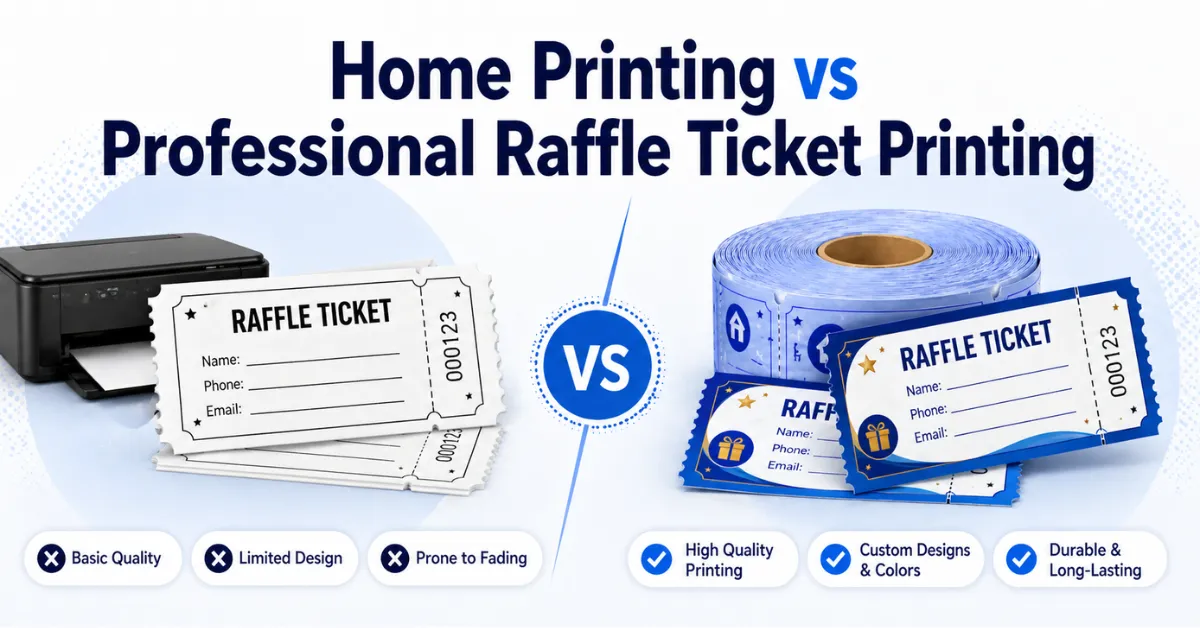
A raffle ticket printer is either a printing company that produces custom, numbered, perforated raffle tickets in bulk, or the home or office printer you use to make tickets yourself. Professional printers handle numbering, perforation, and cutting; home printers usually require you to do all three by hand.
That difference matters more than it sounds. A raffle ticket has a job beyond looking nice: it has to tear cleanly, carry a number that matches its stub, and hold up in a drawing where someone might ask how the winner was chosen. Most raffle ticket printers you’ll find in a home or office don’t perforate, don’t number on their own, and can’t print to the edge of the page.
Home vs. Professional at a Glance
| Factor | Home printing | Professional printing |
| Best for | About 100 tickets or fewer, casual events | 250+ tickets, fundraisers where trust matters |
| Cost per ticket | Looks free; ink, cardstock, and tools add up | About 3¢ to 13¢ on regular size (250 to 5,000 tickets) |
| Perforation | Manual, with a tool | Built in |
| Numbering | Mail merge or by hand | Consecutive numbering included |
| Cutting | Trimmer or scissors | Done for you |
| Paper | Whatever your printer accepts | 20 paper colors, card stock upgrades |
| Time | An afternoon or more | Design online; orders placed by midnight can ship next business day |
| Typical errors | Misfeeds, smudges, mismatched numbers | Proof reviewed before printing |
What Raffle Tickets Really Cost
Comparing a free home print job to a printed price quote isn’t a fair fight. A fair comparison counts everything, including your time.
What Home Printing Really Costs
The expenses most organizers forget:
- Ink or toner. Solid colors and heavy coverage burn through cartridges, and for many printers a single replacement can cost as much as an entire 500-ticket professional order.
- Cardstock. Printer paper tears unevenly and feels flimsy, so most people buy cardstock.
- Tools. A rotary trimmer and a perforating tool, unless you buy pre-perforated ticket stock.
- Waste. Misfeeds, smudges, and crooked prints mean extra sheets.
- Your time. Designing, setting up numbering, test printing, printing, perforating, trimming, and checking every number against its stub is realistically an afternoon for a few hundred tickets, and a second afternoon if something goes wrong.
What Professional Printing Costs (Real Numbers)
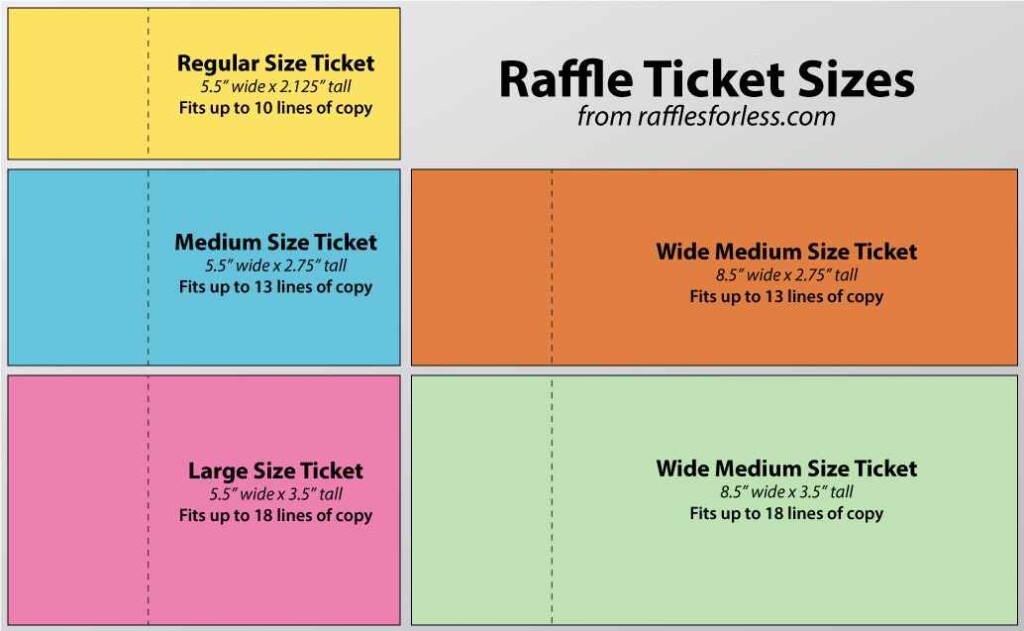
These are regular-size tickets (2-1/8 x 5-1/2 inches) ordered with our Design It Yourself form. Free shipping is available at checkout.
| Quantity | Price | Cost per ticket |
| 250 | $33 | 13.2¢ |
| 500 | $35 | 7.0¢ |
| 1,000 | $37 | 3.7¢ |
| 2,000 | $72 | 3.6¢ |
| 5,000 | $153 | 3.1¢ |
Two things stand out. First, going from 500 to 1,000 tickets costs only $2 more, so it’s cheaper to over-order than to run short and reprint. Second, the setup cost is baked in, which is why small orders cost more per ticket. Larger sizes, two-sided printing, upgraded card stock, gluing, and stapling change the price. Our full raffle ticket pricing page lists every size, and Design It For Me orders add $35 or more.
Before you pick a quantity, work backward from your goal with our guide on how much to charge for raffle tickets.
How to Print Raffle Tickets at Home
If home printing is the right call for your event, do it well. Here is how to print raffle tickets at home without the usual headaches.
What You Need
- A home or office printer (laser handles smudging better than inkjet)
- Matte cardstock your printer’s manual says it can feed
- A rotary paper trimmer
- A perforating tool, or pre-perforated ticket stock
- A spreadsheet or design tool with mail merge or bulk create for numbering
Step by Step
- Set your number range. Pick the starting number and total quantity. Every ticket needs a matching number on its stub.
- Build the ticket. Include the organization name, a specific prize description, ticket price, drawing date, time, and location, the number on both ticket and stub, and lines for the buyer’s name and phone on the stub. Add any wording your state requires.
- Automate the numbers. Put the numbers in a spreadsheet column and use mail merge or a bulk-create feature. Hand-numbering is where most mismatches happen. Our guide on how to make raffle tickets with numbers walks through the setup, and our free raffle ticket templates give you a starting layout.
- Choose paper carefully. Heavy cardstock jams many home printers, so check the maximum paper weight first. Pick a matte finish so stubs accept pen.
- Print one test page. Check alignment, margins, and that the numbers run in order. Most home printers leave margins, so confirm how many tickets actually fit per sheet.
- Print the batch and let it dry. Rushing causes smears when you stack and cut.
- Perforate, then trim. Perforate while tickets are still on the full sheet so the tear lines stay straight, then trim along the cut lines.
- Verify before you hand out a single ticket. Spot-check numbers across the whole run, then bundle tickets in groups of 25 or 50 so volunteers can track them.
Pros and Cons of Home Raffle Ticket Printing
Pros: no minimum order, instant design changes, no shipping wait, and very low cost for tiny runs.
Cons: no built-in perforation, a lot of labor, uneven print quality, numbering errors, and ink costs that climb fast.
Professional Raffle Ticket Printing: What You Get
With professional raffle ticket printing, the hard parts are done before the box arrives. At Raffles For Less, every ticket is consecutively numbered and perforated, and you choose from 5 sizes and 20 paper colors. You can design the ticket yourself online and see a proof instantly, or have a designer build it for you. Stapling or padding tickets into books is available if you want them ready to hand to sellers. We print millions of raffle tickets every year, so your 500-ticket order gets the same careful process as a 50,000-ticket one.
If you want to see the finished product first, browse our raffle ticket samples or compare finishes in our matte vs. glossy raffle tickets guide.
Pros: clean perforation, precise numbering, consistent color, no hand cutting, and a ticket that looks like a real drawing is being run.
Cons: a minimum order (our price list starts at 250), shipping time you have to plan for, and less room for last-minute edits once an order is submitted.
How to Choose a Professional Raffle Ticket Printer
Not every professional raffle ticket printer works the same way. Ask these six questions before you order:
- Are tickets numbered and perforated as part of the price?
- Can you see a proof before you pay?
- What are the real turnaround and shipping costs?
- Is pricing posted at your quantity, with no surprise setup fees?
- Do you get a matte or writable option for stubs?
- Can you reach a person if something looks wrong? (Our number is 570-664-6191.)
Check independent feedback on our customer reviews page, and if you’ve found a lower quote elsewhere, see our price match page. When your date is tight, our fast raffle ticket printing page explains next-business-day shipping.
Which Option Fits Your Raffle?
These are typical scenarios, not customer testimonials.
Example 1: The classroom bake-sale raffle (about 100 tickets). Tickets are $1, the drawing is this Friday, and branding doesn’t matter. Print at home on matte cardstock with a mail-merged number column. You’re below our 250-ticket price list minimum anyway.
Example 2: The booster club raffle (1,500 tickets). Tickets are $5, the drawing is in three weeks, and families will sell them door to door. Professional printing wins: 1,500 regular tickets are $55, and numbering and perforating that many at home would eat a weekend.
Example 3: The parish gala (5,000 tickets). The prize is valuable and records need to be clean. Professional printing is the safe choice: 5,000 regular tickets are $153, and consecutive numbers give you a clear paper trail.
A simple rule: choose home printing only if you need about 100 tickets or fewer, the stakes are low, and you have the time. Choose a professional if you need 250 or more, a polished look, stubs that tear cleanly, or a record you can defend.
Still comparing budget and quality? Our cheap vs. premium raffle tickets guide breaks down where extra spending pays off, and our Raffle Ticket Maker guide covers free generators and design tools in depth.
Raffle Ticket Printing and the Rules
The printer you use doesn’t make a raffle legal or illegal, but ticket wording can matter. Some states require specific language, a license or registration number, or other disclosures on the ticket, and wording is permanent once printed. Check your rules first. We cover two common examples in our guides to raffle laws in Pennsylvania and raffle laws in Florida.
For federal tax rules, IRS Publication 3079, Tax-Exempt Organizations and Gaming explains recordkeeping and reporting duties for exempt organizations that run raffles. The National Council of Nonprofits also has a helpful overview of games of chance. This is general information, not legal or tax advice. Confirm requirements with your state regulator or an attorney.
Mistakes to Avoid
- Printing before checking state rules. Fixing wording means reprinting everything.
- Hand-numbering. One skipped or duplicated number can derail a drawing.
- Glossy stock for stubs. Ballpoint pens skip and smear on coated finishes.
- Skipping the test print. Misaligned margins show up on page one, not page fifty.
- Vague prize text. Write 50-inch smart TV, not just TV.
- Under-ordering. Reprinting rush jobs costs more than adding tickets to the first order.
- Ordering at the last minute. Allow time for production and shipping, not just printing.
Best Practices and Tips
- Make the price and prize the largest text on the ticket.
- Use a matte or uncoated finish so stubs are easy to write on.
- Number both the ticket and the stub identically.
- Have a second person proofread every number, date, and spelling.
- Keep a simple sales log with each seller’s ticket range.
- Use paper colors to separate ticket ranges or sellers.
- Once tickets arrive, put our guide on how to sell more raffle tickets to work. If you want to understand stub design first, read our raffle ticket stubs guide.
Raffle Ticket Printing Checklist
Quantity chosen (goal divided by ticket price, plus a cushion)
Home or professional decision made
State and local rules confirmed
Prize, price, date, time, and location written clearly
Numbers match on every ticket and stub
Matte, writable stub area
Proof or test print reviewed by two people
Order date set early enough for production and shipping
Sales log ready for sellers
Conclusion
The right raffle ticket printer is the one that matches your quantity, deadline, and the level of trust your buyers expect. Home printing is a fair choice for tiny, casual raffles. Once you’re past 250 tickets, or you need clean perforation, reliable numbers, and a professional look, professional printing usually saves both money and hours. When you’re ready, review our pricing and start your custom raffle ticket printing order today.
FAQs
What is a raffle ticket printer?
A raffle ticket printer is either a printing company that produces custom, numbered, perforated raffle tickets in bulk, or the home or office printer you use to make tickets yourself. Professional printers handle numbering, perforation, and cutting; home printers usually require you to do all three by hand.
Is it cheaper to print raffle tickets at home?
Home printing is usually cheaper only for very small raffles, roughly 100 tickets or fewer. Once you count ink, cardstock, a paper trimmer, perforating, and hours of labor, a professional order often costs less. For example, 500 regular tickets from Raffles For Less start at $35 with free shipping, numbered and perforated.
How do I print raffle tickets at home with numbers?
Create your ticket layout, add a number field with mail merge or a bulk-create tool, and print a test page. Confirm that the ticket and stub numbers match, then print the batch on matte cardstock your printer can handle. Finally, perforate and trim each sheet, and spot-check the sequence before handing out tickets.
Can a home printer perforate raffle tickets?
No. Standard home and office printers only print; they don’t perforate. You can add tear lines afterward with a perforating tool, buy pre-perforated ticket stock, or order from a professional raffle ticket printer that perforates every ticket as part of the job.
How much does professional raffle ticket printing cost?
At Raffles For Less, regular-size tickets (2-1/8 x 5-1/2 inches) start at $33 for 250, $35 for 500, and $37 for 1,000 with the Design It Yourself form. Free shipping is available. Larger sizes, two-sided printing, upgraded card stock, gluing, and stapling change the price.
How long does professional raffle ticket printing take?
Raffles For Less offers 24-hour turnaround, and orders placed by midnight can ship the next business day. Delivery time then depends on the shipping option you choose, so order early and use expedited shipping if your drawing date is close.
What size are raffle tickets?
Raffles For Less offers five sizes: regular (2-1/8 x 5-1/2 inches), medium (2-3/4 x 5-1/2), large (3-1/2 x 5-1/2), medium wide (2-3/4 x 8-1/2), and large wide (3-1/2 x 8-1/2). Regular is the lowest-priced option.
What paper is best for raffle tickets?
Medium-weight cardstock with a matte finish is the safest choice. It feels sturdy, tears cleanly along perforations, and takes ballpoint pen on the stub without smearing. Glossy stock looks vibrant but can smudge when buyers write their name and phone number.