Raffle Ticket Books: What They Are, How to Choose One, and Where to Buy Them
Raffle ticket books make running a raffle simpler, more organized, and more professional but only if you pick the right format for your event. If you’re planning a school fundraiser, church raffle, or team booster drive, the difference between a good ticket book and a bad one shows up on the night you’re trying to sell tickets at a table, track who bought what, and pull a winner without an argument.
This guide walks through what raffle ticket books actually are, the features that matter most, how many tickets you actually need, and what to look for before you order whether you’re buying pre-made booklets or having them custom printed.
What Is a Raffle Ticket Book?
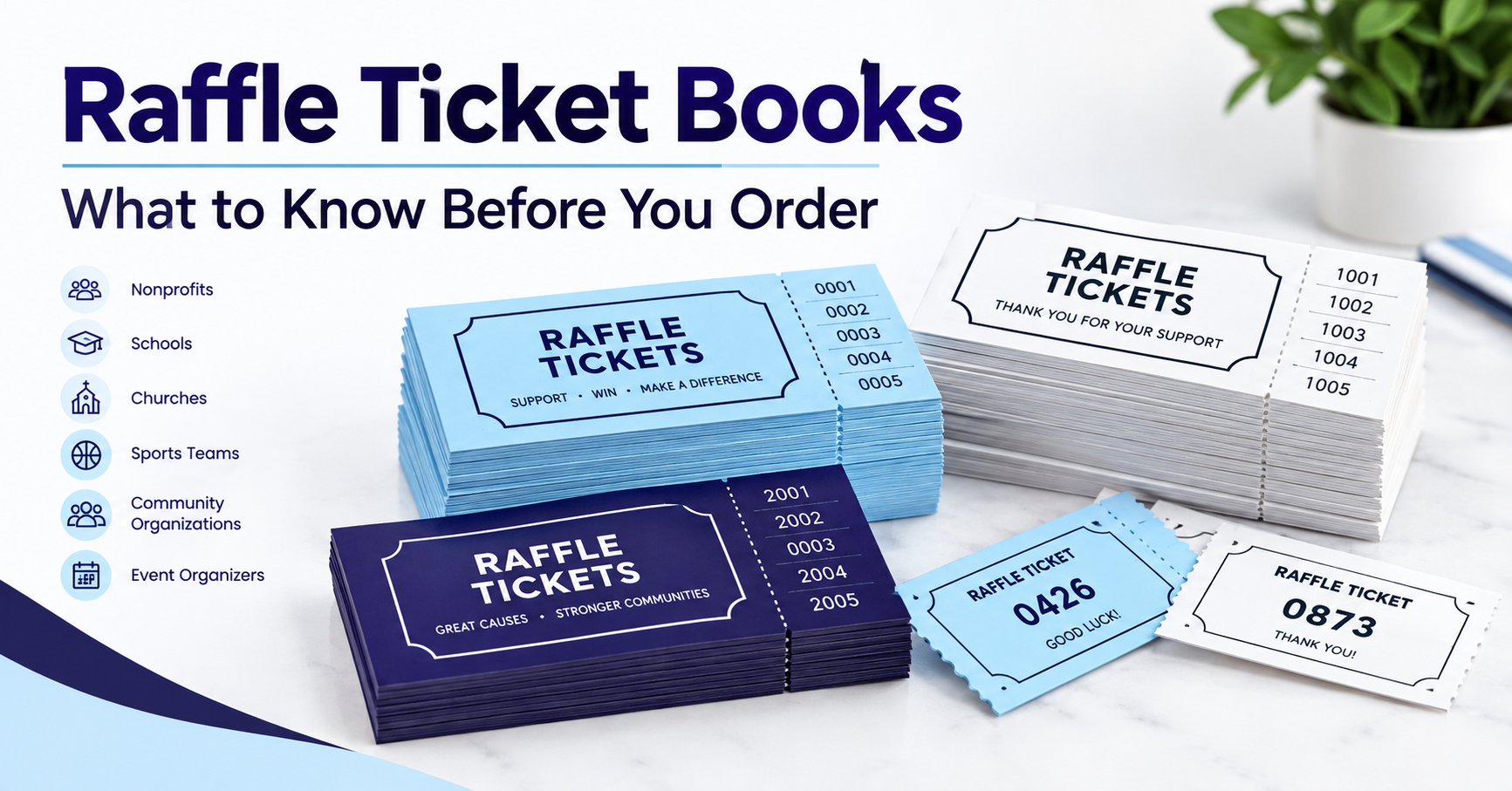
A raffle ticket book is a bound set of raffle tickets, usually 25 to 100 per book, where each ticket is perforated so it splits into two matching halves: one half for the buyer to keep and one half (the stub) for the organizer to drop into the drawing container. Most books are sequentially numbered so both halves of a ticket carry the same number, which is what makes it possible to match a winning stub back to the person holding the matching ticket.
Compare that to loose raffle tickets sold in a single roll or stack they work, but they’re harder to organize at a table, easier to lose track of, and don’t hand out as cleanly to volunteers who are each selling a section of tickets.
Why Ticket Books Are the Standard for Organized Raffles
Ticket books solve a handful of practical problems that come up in almost every raffle:
- They keep sellers organized. Each volunteer can be handed their own book (or set of books) with a known ticket range, which makes reconciling money at the end of the night much faster.
- They reduce disputes over winners. A numbered stub-and-ticket system means you can verify a winner on the spot instead of relying on handwritten names that might be smudged, misspelled, or missing.
- They look more professional. A well-designed, perforated, numbered book signals to donors and prize sponsors that the event is being run carefully which matters more than people expect when you’re asking for prize donations year after year.
- They scale with the event. Whether you need 200 tickets for a small classroom raffle or 10,000 for a large gala, books can be ordered in the exact quantity and configuration the event calls for.
Key Features to Look for in a Raffle Ticket Book
Not all raffle ticket books are built the same way. Before you order, check for these details.
Numbering
Sequential numbering is what makes a raffle auditable. Look for books where each ticket and its matching stub share an identical number, and confirm whether you need a single number series across your whole event or separate series per book (useful when multiple volunteers are selling at once and you want to avoid confusion).
Perforation
The perforation is the line that lets the ticket cleanly separate into a stub and a keeper portion. Weak or uneven perforation is one of the most common complaints with cheap raffle tickets it tears unevenly, rips into the printed information, or doesn’t separate at all under a table full of hands. A clean perforation matters more than most buyers expect until they’ve run a raffle with tickets that don’t tear right.
Stub Layout
The stub is what goes into the drawing container, so it needs to have enough space for a name, phone number, and email address legibly, in a pen someone is writing with standing up at a folding table. Cramped stubs lead to illegible entries and, occasionally, unreachable winners.
Paper Stock and Print Quality
Card stock that’s too thin feels cheap and tears unpredictably along the perforation. Print quality also affects how easily ticket numbers can be read at a glance during the drawing, especially in a dim event hall.
Custom vs. Pre-Made
Pre-made generic books work for quick, informal raffles. Custom raffle ticket books with your organization’s name, event date, prize description, and ticket price printed directly on the ticket tend to raise more money because they look like an official part of the event rather than a generic accessory, and they eliminate the need to explain event details verbally to every buyer. Custom raffle ticket books also make it easier to comply with state disclosure requirements that ask for specific information printed on the ticket itself (more on that below).
How Many Tickets Do You Actually Need?
This is one of the most common questions organizers run into, and it depends on two things: how many people you expect to sell to, and how many tickets you want each person to be able to buy.
A simple way to estimate:
- Estimate your buyer pool. Count expected attendees, plus any online or pre-sale audience.
- Estimate tickets per buyer. Most raffles see buyers purchase 2–6 tickets each, especially when tickets are sold in small bundles (like “1 for $5, 5 for $20”).
- Multiply and add a buffer. Multiply your buyer estimate by the average tickets per buyer, then add roughly 15–20% extra so you don’t run out mid-event.
If you’re also trying to figure out what to actually charge per ticket or per bundle, our guide on how to price raffle tickets walks through that decision in more detail, and our raffle odds calculator guide can help you decide how many total tickets to print relative to your prize value.
Custom Raffle Ticket Books vs. Generic Booklets
| Feature | Generic Pre-Made Books | Custom Raffle Ticket Books |
| Branding | None blank or generic template | Organization name, logo, event details printed |
| Sequential numbering | Sometimes limited or shared across buyers | Can be set to your exact quantity and range |
| Legal disclosure fields | Often missing | Can include price, drawing date, and other required fields |
| Perceived value to buyers | Lower looks informal | Higher looks like an official event product |
| Turnaround | Immediate (off-the-shelf) | Requires print lead time, but design help is often included |
| Best for | Very small, informal raffles | School, church, nonprofit, and team fundraisers of any size |
For most organized fundraisers schools, churches, booster clubs, and nonprofits custom ticket book printing pays for itself through higher perceived value and fewer administrative headaches, even for relatively small events.
What to Include on a Raffle Ticket
Regardless of whether you go custom or generic, a well-designed raffle ticket book should include:
- Organization name and event name
- Date, time, and location of the drawing
- Prize description (or a reference to where full prize details are listed)
- Ticket price
- A sequential ticket number on both the ticket and stub
- Space on the stub for the buyer’s name, phone number, and email
Some states require additional disclosures on raffle tickets, such as the sponsoring organization’s registration number or a statement that no purchase is necessary in certain contexts. Raffle regulations vary significantly by state, county, and organization type (nonprofit, school, religious organization, etc.), so it’s worth checking with your state’s gaming or charitable solicitations authority before finalizing your ticket wording, rather than assuming last year’s rules still apply.
Common Mistakes When Ordering Raffle Ticket Books
Ordering too few tickets. Running out of tickets mid-sale is a lost revenue opportunity that’s hard to recover once the event has momentum. It’s almost always better to overprint slightly than run short.
Skipping the perforation test. If you’re ordering in bulk, ask about paper weight and perforation quality before committing to a large order a book that doesn’t tear cleanly becomes a real problem once you’re standing at a table with a line of buyers.
Leaving out required disclosures. Missing legally required information on the ticket can create compliance issues after the fact, which is avoidable by checking your state’s requirements before tickets go to print.
Not planning numbering across multiple sellers. If several volunteers are selling simultaneously, decide in advance whether each gets a distinct number range or whether numbering is centralized sorting this out after tickets are already printed is far harder.
Choosing tickets that don’t match the event’s tone. A black-tie gala raffle and a school carnival raffle call for different designs; generic clip-art tickets can undersell an otherwise well-run event.
Where to Buy Raffle Ticket Books
When you’re ready to order, look for a printer that offers:
- Custom design or DIY template options, so you’re not stuck with a generic layout
- True sequential numbering across your full order
- Perforated, tear-resistant stock
- Reasonable turnaround time relative to your event date
- Straightforward pricing at the quantities nonprofits and schools actually need
Raffles For Less prints custom, numbered, perforated raffle ticket books for U.S. nonprofits, schools, churches, and community organizations, with design support for groups that don’t have a designer on staff and free shipping on orders. If you already have a design in mind, you can start from a raffle ticket template and customize it, or see current options on the pricing page.
If you’re running a school fundraiser specifically, our school raffle fundraiser guide covers additional planning considerations beyond ticket design, and if you’re structuring an early bird incentive alongside your main raffle, the early bird raffle guide explains how that structure works.
Frequently Asked Questions
How many tickets come in a raffle ticket book?
Most standard raffle ticket books contain 25, 50, or 100 tickets, though custom orders can be printed in whatever quantity your event needs.
Do raffle ticket books need to be numbered?
Numbering isn’t legally required everywhere, but it’s strongly recommended. Sequential numbers on matching tickets and stubs let you verify winners accurately and keep sales organized.
Can I design my own raffle ticket book?
Yes. Many printers, including Raffles For Less, offer DIY design tools or downloadable templates so you can customize your own layout, or you can submit a design for full custom printing.
What’s the difference between a raffle ticket book and a raffle ticket roll?
A book is bound and perforated with individual numbered tickets, typically easier to hand out to individual sellers. A roll is continuous and usually used for higher-volume, less formal sales, like at a fair or carnival booth.
Do I need a permit to sell raffle tickets?
In many states and municipalities, nonprofits need to register or obtain a permit before running a raffle, though requirements vary widely. Check with your state’s charitable gaming or attorney general’s office to confirm what applies to your organization.
How much should I charge per raffle ticket?
Pricing depends on your prize value, audience, and fundraising goal. Our guide on how much to charge for raffle tickets breaks down a practical approach to setting a price.
How far in advance should I order raffle ticket books?
Custom printed books need lead time for design approval, printing, and shipping, so it’s best to order several weeks before your event, especially during busy fundraising seasons like spring and fall.
Can raffle ticket books be personalized with my organization’s logo?
Yes personalized ticket books can include your logo, event name, colors, and other branding details as part of a custom order.