Choosing the right raffle ticket paper can make a bigger difference than you might expect. A raffle ticket needs to survive handling, carry clear printing, separate cleanly, and give participants confidence that the event is organized and legitimate.
For a small informal giveaway, ordinary printer paper may be enough. But for a school fundraiser, charity event, church raffle, nonprofit campaign, or large community drawing, the right ticket paper type matters.
The best choice usually comes down to four things: paper weight, durability, perforation, and how the tickets will be printed and handled.
This guide explains the most common raffle ticket paper options, when to use cardstock, why perforation matters, what paper is used for tickets, and how to choose the right stock for your event.
What Is the Best Paper for Raffle Tickets?
For most professional fundraisers, perforated cardstock or durable ticket stock paper is the best choice. It provides enough strength for repeated handling while allowing ticket stubs to separate cleanly.
For a very small informal raffle, lighter paper can work. For larger events, however, professionally printed, numbered and perforated tickets are generally more practical because the tickets are easier to distribute, track and validate.
Best paper by situation
| Raffle situation | Recommended paper |
| Small informal giveaway | Standard or lightweight paper |
| School fundraiser | Medium-weight perforated stock |
| Church raffle | Durable perforated stock |
| Charity fundraiser | Cardstock or premium ticket stock |
| Large community raffle | Numbered perforated cardstock |
| Corporate event | Premium cardstock |
| High-value prize raffle | Durable stock with additional security features |
| DIY home printing | Printer-compatible cardstock |
The most important point is that there is no single paper that is perfect for every raffle. Your ticket paper type should match the way your tickets will be printed, sold, separated and collected.
Why Does Raffle Ticket Paper Matter?
A raffle ticket is more than a piece of paper.
It may be handled by sellers, folded into wallets, carried around an event, separated at a perforation, placed into a drawing container, and retained by the winner. If the stock is too thin or the perforation is poorly designed, problems can appear before the drawing even begins.
Good raffle paper should provide:
- Clear, readable printing
- Enough strength for normal handling
- Clean separation between ticket and stub
- Space for sequential numbers
- A professional appearance
- Compatibility with the selected printing method
- Easy organization during ticket distribution
Paper quality also works together with other ticket features. A professional ticket normally combines suitable stock with clear information, numbering and a practical layout.
For guidance on the information your ticket should contain, see our guide to What Information to Include on a Raffle Ticket?.
What Paper Is Used for Tickets?
The most common choices are standard paper, heavier text stock, cardstock and perforated ticket stock.
The right option depends on whether you’re printing tickets yourself or ordering professionally printed tickets.
1. Standard Printer Paper
Standard office paper is inexpensive and easy to find. It can work for very small, informal raffles where appearance and durability are not major concerns.
However, ordinary printer paper has limitations.
It is relatively thin, can tear easily and does not provide the sturdy feel associated with professionally printed tickets. It is also more difficult to create clean tear-off stubs without additional cutting or perforating equipment.
Best for:
- Small internal giveaways
- Practice designs
- Temporary event materials
- Very low-volume raffles
Not ideal for:
- Large fundraisers
- Public charity raffles
- Tickets with tear-off stubs
- Events where tickets will receive heavy handling
2. Cardstock
Cardstock is a popular choice when you want a more substantial ticket.
Compared with ordinary office paper, cardstock is thicker and generally more resistant to bending and tearing. It can also give a ticket a more professional physical feel.
However, thicker is not automatically better.
The stock must still be compatible with the printer and finishing method. Extremely heavy material may not feed correctly through some office printers.
For DIY printing, always check your printer manufacturer’s recommended media weight before purchasing a large quantity.
3. Perforated Ticket Stock
Perforated paper for raffle tickets has pre-made tear lines that allow the ticket and stub to separate cleanly.
This is particularly useful when every ticket needs a detachable section for the drawing.
Instead of cutting each ticket manually, the perforation provides a consistent separation point.
Benefits include:
- Faster ticket preparation
- Cleaner separation
- Consistent ticket sizes
- Easier stub collection
- Less manual cutting
- More professional presentation
For fundraisers selling hundreds or thousands of tickets, perforation can save considerable preparation time.
Our guide on Perforated vs. Non-Perforated Raffle Tickets explains when each format makes sense.
Perforated Paper vs. Cardstock: Which Is Better?
These terms describe different characteristics, so they are not necessarily alternatives.
Cardstock describes the weight and stiffness of the material.
Perforated describes how the ticket is finished.
That means you can have perforated cardstock.
For a professional fundraiser, that combination can be particularly useful because it provides both durability and a convenient tear-off stub.
| Feature | Standard paper | Cardstock | Perforated cardstock |
| Durability | Low | High | High |
| Professional feel | Low | High | High |
| Tear-off stub | No | Not automatically | Yes |
| Easy separation | Low | Medium | High |
| DIY friendly | High | Medium | Medium |
| Large raffle suitability | Low | High | Excellent |
Understanding Ticket Stock Paper Weight
When shopping for ticket stock paper, you’ll encounter different ways of describing thickness.
In the United States, paper may be described using terms such as pounds, points or GSM depending on the supplier and material.
Don’t choose paper based on thickness alone.
A better question is:
Will this stock perform properly with my printer, design and ticket format?
For example, a heavier stock may look excellent but could cause feeding problems in a home printer that is designed primarily for lighter media.
A practical approach
For DIY tickets, start by checking:
- Your printer’s supported media weights.
- Whether the printer uses a straight or curved paper path.
- Whether the ticket requires perforation.
- Whether you need double-sided printing.
- Whether the finished ticket needs to be folded, stapled or glued.
For professionally printed tickets, the printer can recommend a stock that works with the selected format and finishing options.
How to Choose the Right Raffle Ticket Paper
Use this five-step process before ordering your tickets.
Step 1: Determine How the Tickets Will Be Used
Ask how much handling the tickets will receive.
A ticket sold at a one-hour school event has different requirements from a ticket sold over several weeks.
If tickets will be carried around for days or weeks, choose a more durable material.
Step 2: Decide Whether You Need a Stub
If your drawing requires participants to keep one portion while the organization collects another, use a ticket with a perforated stub.
A matching number on both sections makes winner verification easier.
Sequential numbering is especially useful for maintaining an organized ticket system. Our guide on the purpose of the numbers on raffle tickets explains how numbering supports tracking and verification.
Step 3: Check Your Printer
If you’re printing at home or in an office, confirm that your printer can handle your chosen material.
Consider:
- Paper weight
- Sheet size
- Inkjet or laser compatibility
- Manual-feed requirements
- Border limitations
- Double-sided printing capability
Never assume that every cardstock product will work in every printer.
Step 4: Match the Paper to Your Event
Your event can help determine the right balance between cost and presentation.
School fundraiser: Choose practical, durable stock that keeps costs manageable.
Church raffle: Perforated stock is useful when volunteers need to separate stubs quickly.
Charity fundraiser: A professional-looking ticket can reinforce confidence in the organization.
Corporate event: Premium stock can complement a polished brand identity.
Large community raffle: Prioritize durability, numbering and efficient handling.
Step 5: Consider Quantity
The more tickets you need, the more important production efficiency becomes.
Printing 50 tickets yourself is very different from preparing 5,000 tickets.
At higher quantities, professional printing can eliminate repetitive work such as printing, cutting, numbering and manually creating ticket stubs.
Paper Raffle Tickets: DIY or Professional Printing?
Both approaches can work.
The better option depends on your quantity, deadline, equipment and desired finish.
DIY printing
DIY can make sense when you have:
- A small ticket quantity
- A suitable printer
- Design software
- Time for setup
- Basic cutting or perforating equipment
The biggest challenge is consistency.
You need to make sure every ticket is aligned, numbered correctly and separated cleanly.
For a practical DIY guide, see How to Make Raffle Tickets at Home.
Professional printing
Professional printing becomes more attractive when you need hundreds or thousands of tickets.
Advantages can include:
- Consistent printing
- Professional perforation
- Sequential numbering
- Multiple sizes
- Multiple paper colors
- Booklet options
- Less preparation work
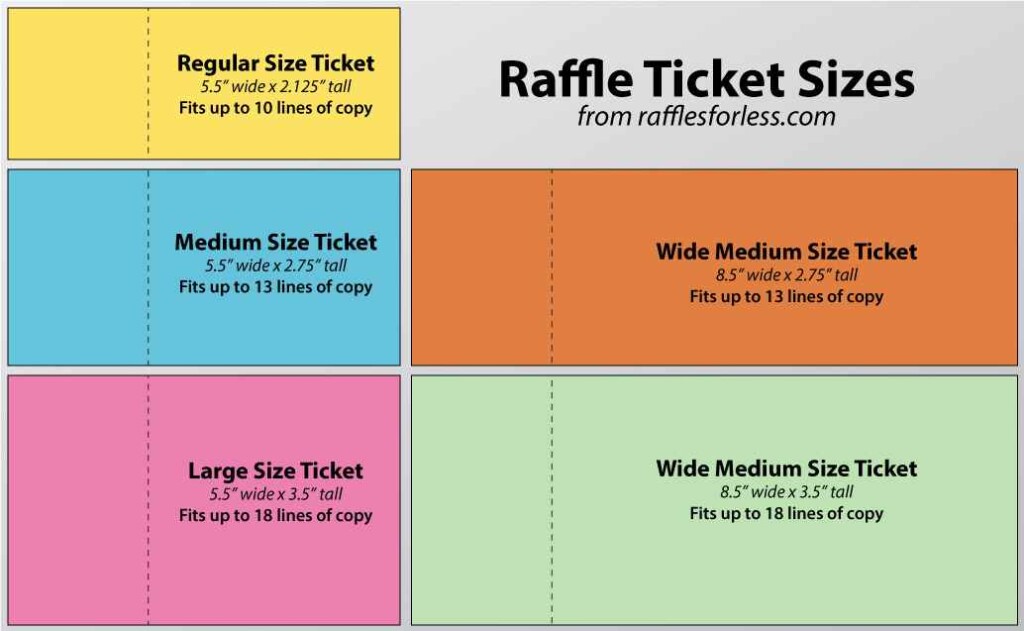
Raffles For Less currently offers five standard ticket sizes plus calendar ticket formats, with tickets that are numbered and perforated.
You can review available formats on the Raffles For Less Order Forms.
What Paper Should You Use for Different Raffles?
Here’s a simple decision guide.
School Fundraisers
Schools often need an affordable solution that is easy for volunteers to sell.
Choose durable, perforated stock with clear numbering and enough space for event information.
Avoid spending heavily on premium finishing if the raffle is primarily focused on keeping ticket costs low.
Church Raffles
Church raffles often depend on volunteers distributing tickets before and during an event.
A perforated format makes it easier to separate the participant portion from the drawing stub.
Keep the design simple and make the organization, event and prize information easy to read.
Charity Fundraisers
Charity events benefit from professional presentation.
A durable ticket with clean printing, consistent numbering and a well-designed stub can make the entire fundraiser feel more organized.
Your ticket should support trust rather than distract from the cause.
Corporate Raffles
Corporate events often place more emphasis on branding.
Consider heavier stock and a polished design that matches the organization’s colors and visual identity.
You can also explore Raffle Ticket Design Tips to Sell More Tickets for practical layout guidance.
Large Fundraising Events
For large raffles, focus on operational efficiency.
You may need:
- Sequential numbering
- Perforated stubs
- Bulk printing
- Multiple ticket books
- Consistent ticket stock
- Clear seller tracking
The paper is only one part of the system. Your ticketing process should be designed around how tickets will actually be distributed and collected.
How Paper Quality Affects Ticket Appearance
Paper does not replace good design, but it can affect how the finished ticket feels and prints.
A strong ticket design should have:
- Readable typography
- Clear contrast
- A logical information hierarchy
- Adequate space
- Prominent prize information
- Easy-to-find ticket numbers
- Clearly defined stub information
Avoid filling every available inch with text.
A clean design on appropriate stock will usually look more professional than a crowded design printed on expensive paper.
7 Raffle Ticket Paper Mistakes to Avoid
Choosing the wrong raffle ticket paper can create unnecessary problems.
1. Using paper that is too thin
Thin paper may tear during normal handling and can make the ticket feel less substantial.
2. Choosing stock your printer cannot handle
Always check printer specifications before buying large quantities of cardstock.
3. Forgetting the perforation
If your process requires a tear-off stub, plan for perforation from the beginning.
4. Ignoring ticket size
A beautiful design will not help if there isn’t enough space for required information.
5. Printing without testing
Print a sample before producing the entire batch.
Check:
- Alignment
- Number placement
- Color
- Text size
- Perforation position
- Front and back registration
6. Manually numbering large quantities
Manual numbering creates opportunities for duplicates and skipped numbers.
For larger raffles, use a controlled numbering system or professional numbering service.
7. Prioritizing the cheapest paper over the overall value
The lowest material price is not always the lowest total cost.
If cheap paper requires additional cutting, numbering, reprinting or replacement, the savings can disappear quickly.
For more guidance, read Top 5 Mistakes to Avoid When Printing Raffle Tickets.
Raffle Ticket Paper Buying Checklist
Before ordering raffle paper, confirm each of these items:
Paper checklist
- Appropriate paper weight
- Compatible with your printer
- Correct ticket dimensions
- Perforated if a stub is required
- Durable enough for expected handling
- Suitable color for your design
- Enough room for ticket numbers
- Space for required event information
- Sample or proof reviewed
- Quantity confirmed
- Numbering sequence confirmed
- Delivery date allows enough preparation time
If you are ordering professionally, compare your ticket size and quantity before making a decision. Raffles For Less publishes current ticket pricing and size options on its Raffle Ticket Pricing page.
Legal Considerations Before Printing
Paper selection does not determine whether a raffle is legal.
Raffle requirements can vary by state and locality, so organizers should verify applicable rules before selling tickets. Depending on the jurisdiction, regulations may address eligibility, ticket wording, licensing, prize values, record keeping and how the raffle can be conducted.
The IRS also treats raffle winnings as gambling winnings for federal tax purposes. The IRS states that gambling winnings include raffle prizes and that certain raffle winnings may trigger reporting or withholding requirements.
For the legal requirements applicable to your event, consult the appropriate state or local authority rather than relying solely on a general online guide.
When Should You Order Professional Raffle Tickets?
Consider professional printing if:
- You need several hundred or more tickets.
- You need sequential numbering.
- You need clean perforated stubs.
- Your event requires consistent branding.
- You do not have suitable printing equipment.
- You have limited preparation time.
- Volunteers would otherwise need to cut and assemble tickets manually.
Raffles For Less offers custom ticket sizes, paper colors, numbering, perforation and optional book finishing. Its current site also advertises free shipping and fast production options.
For organizers comparing professional printing with DIY production, our professional raffle ticket printing guide provides additional considerations.
Best Practices for Professional Raffle Tickets
The strongest ticket isn’t necessarily the thickest ticket.
Instead, aim for the right combination of:
Durability + readability + perforation + numbering + practical size + clean design.
A good ticket should be easy for your team to sell, easy for participants to understand and easy for organizers to validate during the drawing.
Before sending the final batch to production, proof everything.
Check the event name, date, drawing information, prize description, ticket price, organization name, contact details, numbering and any legally required wording.
A few minutes of careful proofreading can prevent an expensive reprint.
Frequently Asked Questions
What is the best paper for raffle tickets?
The best paper for raffle tickets is usually durable cardstock or ticket stock with perforation when a detachable stub is required. The ideal choice depends on your printer, ticket format, event size and how heavily the tickets will be handled.
What paper is used for tickets?
Tickets are commonly printed on paper stock, cardstock or specialized perforated ticket stock. Professional raffle tickets often use durable stock combined with perforation and sequential numbering for easier handling and verification.
Is cardstock good for raffle tickets?
Yes. Cardstock is a strong option when durability and presentation matter. However, make sure the stock is compatible with your printer if you’re producing the tickets yourself.
Do raffle tickets need perforated paper?
Not every raffle requires perforation. Perforation is useful when you need a detachable stub for collecting entries, recording information or conducting the drawing. It is particularly practical for traditional physical raffle tickets.
What is perforated paper for raffle tickets?
Perforated paper for raffle tickets contains a pre-made tear line that allows part of the ticket to be removed cleanly. This eliminates much of the manual cutting required with ordinary sheets of paper.
What is ticket stock paper?
Ticket stock paper is paper or cardstock specifically selected for tickets because it provides the appropriate combination of durability, printability and handling characteristics. Some ticket stock is also perforated for easy separation.
Conclusion: Choose Raffle Ticket Paper for the Whole Event
The right raffle ticket paper should do more than look good.
It should withstand handling, print clearly, separate cleanly when necessary and support an organized drawing process. For many fundraisers, perforated cardstock or durable ticket stock provides a strong balance of professionalism and practicality.
Before choosing your raffle ticket paper, consider your event size, ticket format, printer, required stub, numbering system, and budget.
For a small DIY raffle, suitable cardstock may be all you need. For a larger fundraiser, professionally printed and perforated tickets can save time while delivering consistent quality.
If you’re ready to compare ticket sizes, formats, and production options, review the Raffles For Less Order Forms and choose the format that fits your event.