Planning a school fundraiser, charity event, church raffle, or community drawing? Printing expenses can affect how much money your organization ultimately raises. Bulk raffle ticket printing can help reduce the average cost per ticket, simplify preparation, and provide professionally printed tickets for your fundraising campaign.
However, ordering more tickets does not automatically mean saving more money. If your organization prints thousands of tickets but sells only a small portion, the unused inventory can offset the savings.
The smarter approach is to compare raffle ticket prices, estimate how many tickets you expect to sell, and choose a quantity that fits your budget. This guide explains how bulk printing works, how to calculate printing costs, how to price tickets, and how to choose affordable custom tickets without sacrificing quality.
What Is Bulk Raffle Ticket Printing?
Bulk raffle ticket printing means ordering a larger quantity of tickets in a single production run instead of placing several smaller orders. Larger orders can reduce the average cost per ticket because certain production expenses are spread across more tickets.
Professionally printed tickets can include custom designs, sequential numbering, perforated stubs, event details, and organization branding. These features help volunteers distribute tickets and manage entries during the drawing.
Bulk printing can be particularly useful for:
- Schools organizing annual fundraising campaigns.
- Churches running seasonal events.
- Nonprofits selling tickets over several weeks.
- Sports teams raising money for equipment or travel.
- Community organizations hosting recurring raffles.
- Event organizers managing multiple sales teams.
The ideal order quantity depends on expected demand, available budget, event timing, and whether unused tickets can be used for future events.
How Bulk Printing Saves Money
There are several reasons bulk raffle ticket printing can help organizations control their fundraising expenses.
1. Lower Average Cost Per Ticket
Printing prices often vary by quantity, ticket dimensions, paper stock, and finishing options. When the price per ticket decreases at higher quantities, your organization can spend less on each entry.
For example, an organization ordering 2,500 tickets may pay less per ticket than one ordering 250 tickets. The actual savings depend on the printer’s current prices and the specifications selected.
2. Fewer Repeat Orders
Ordering an appropriate quantity at the beginning may eliminate the need for another print run halfway through your campaign.
Repeat orders can involve additional shipping expenses, administrative work, and delays. Planning ahead helps reduce the risk of running out of tickets while volunteers are still selling them.
3. Less Volunteer Preparation
Printing tickets at home can require designing layouts, purchasing paper, cutting sheets, numbering tickets, and creating detachable stubs.
Professional raffle ticket printing can reduce this workload because tickets may arrive ready for distribution, depending on the selected product and finishing options.
4. Consistent Design and Numbering
A single production run helps maintain consistent ticket dimensions, colors, layouts, and numbering. This is particularly useful when several volunteers are selling tickets at different locations.
Clear, professional tickets can also help participants identify the organization, prize, drawing date, and entry number.
5. Better Budget Planning
Knowing your printing expense in advance makes it easier to allocate funds for prizes, advertising, event supplies, and other fundraising needs.
Remember that lower printing costs can improve your net proceeds, but they do not automatically increase sales. Your overall results still depend on demand, pricing, promotion, and expenses.
How to Calculate Raffle Ticket Printing Costs
The easiest way to compare printing options is to calculate the average cost per ticket.
Cost per ticket = Total printing cost ÷ Number of tickets ordered
For example, if your organization spends $100 on 2,500 tickets, the printing cost is four cents per ticket.
Example of Bulk Printing Prices
The following figures are illustrative examples, not current supplier quotations.
| Quantity | Total order cost | Cost per ticket |
| 250 | $35 | 14 cents |
| 500 | $40 | 8 cents |
| 1,000 | $45 | 4.5 cents |
| 2,500 | $90 | 3.6 cents |
| 5,000 | $160 | 3.2 cents |
These examples show how a larger order can lower the average cost per ticket while increasing the initial expense.
Before ordering, compare the actual prices for your chosen size and printing options on the Raffles For Less pricing page.
Calculate the Cost of Tickets You Actually Sell
Printing cost per ticket and effective cost per ticket sold are different measurements.
Suppose you spend $90 on 2,500 tickets but sell only 1,000. Your printing expense per ticket sold is nine cents, even though the average cost per printed ticket is 3.6 cents.
The remaining tickets may still have value if you can use them for another event. If they contain an expired drawing date or a one-time event name, however, they may become unusable.
When comparing cheap raffle ticket printing, consider the total order price, expected sales, and the possibility of leftover inventory.
Bulk Printing vs. Small-Batch Printing
Choosing between bulk and small-batch production depends on your expected sales and available budget.
| Factor | Bulk printing | Small-batch printing |
| Initial expense | Usually higher | Usually lower |
| Cost per ticket | May be lower | May be higher |
| Inventory | More tickets available | Fewer tickets available |
| Unused-ticket risk | Potentially higher | Potentially lower |
| Volunteer workload | Usually less preparation | Depends on the printing method |
| Best fit | Established or larger campaigns | Smaller or uncertain campaigns |
When Bulk Printing Makes Sense
A larger order may be appropriate when your organization has reliable sales data, a large supporter base, several volunteers, or a fundraising campaign that lasts several weeks.
For a more detailed comparison, read bulk vs. small-batch raffle tickets.
When Small-Batch Printing Is Better
Smaller orders may make more sense when you are organizing your first fundraiser, testing a new event idea, or working with a limited upfront budget.
They can also be useful when event details change frequently and you want to avoid printing tickets that might become outdated.
Is Cheap Raffle Ticket Printing Always Better?
Not necessarily. The lowest advertised price may not provide the best overall value.
Consider the paper quality, numbering, perforation, finishing, shipping, and time your volunteers would spend preparing tickets themselves. Paying for features you do not need can also increase costs unnecessarily.
The goal is to find custom raffle tickets cheap enough for your budget while retaining the features your event requires.
How to Choose the Right Ticket Quantity
Ordering the right quantity begins with a realistic sales estimate rather than a guess.
Step 1: Review Previous Fundraising Results
If your organization has held similar raffles before, examine how many tickets were printed, distributed, sold, and returned.
Past results provide a useful starting point for forecasting future demand.
Step 2: Estimate Your Potential Buyers
Consider your audience size, number of volunteers, promotional activities, sales period, and prize appeal.
Do not assume that everyone who attends your event will purchase a ticket.
Step 3: Estimate Ticket Sales
Use this simple calculation:
Expected buyers × Average tickets purchased per buyer = Estimated demand
For example, if you expect 300 buyers to purchase an average of five tickets each, your estimated demand is 1,500 tickets.
This is a planning estimate, not a guarantee.
Step 4: Add a Reasonable Buffer
Consider whether you need extra tickets for additional volunteers, unexpected demand, or new sales locations.
The appropriate buffer depends on how predictable your campaign is. An established fundraiser may have a more reliable forecast than a first-time event.
Step 5: Compare Available Quantities
Compare the total cost and cost per ticket for quantities close to your estimate. Avoid ordering substantially more than you can reasonably sell simply to obtain a lower unit price.
Step 6: Choose the Right Format
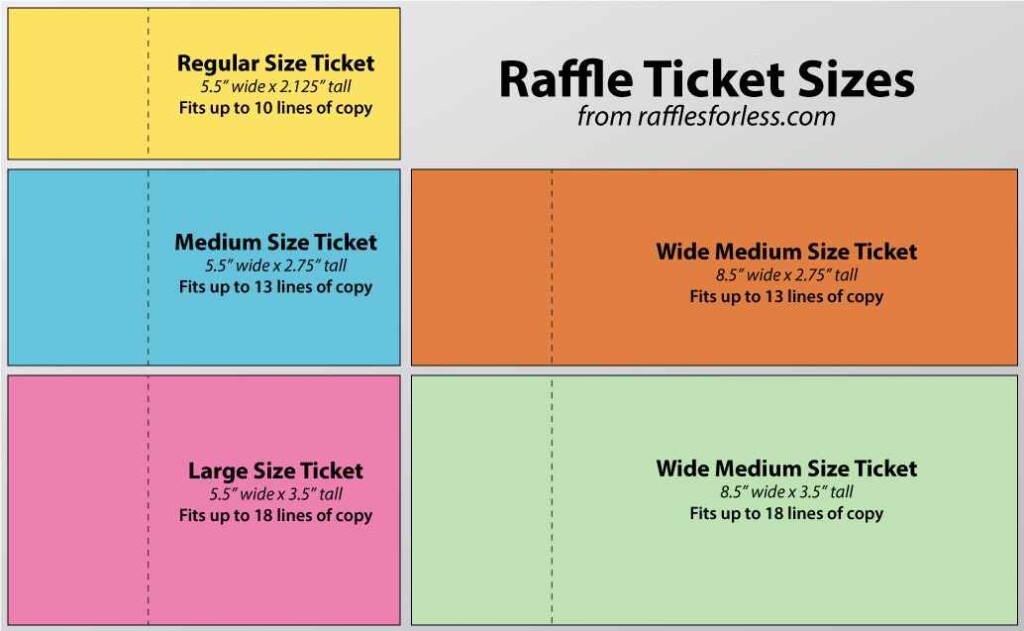
Your ticket should provide enough space for the event name, prize details, ticket price, drawing date, and other necessary information.
Review the available raffle ticket sizes and formats before finalizing your order.
How to Price Raffle Tickets for Fundraising
Printing costs are only one part of your fundraising budget. Your selling price should account for prize expenses, event costs, expected sales, and the amount your organization hopes to raise.
If you are deciding how to price raffle tickets, start by calculating your revenue target.
Example Fundraising Budget
Suppose your organization wants to raise $3,000 after expenses.
| Budget item | Amount |
| Prize expenses | $800 |
| Ticket printing | $100 |
| Advertising and supplies | $300 |
| Total expenses | $1,200 |
| Desired net proceeds | $3,000 |
| Required gross revenue | $4,200 |
If you expect to sell 700 tickets, you would need an average selling price of $6 per ticket to generate $4,200 in revenue.
This is a mathematical starting point, not necessarily the ideal price for your audience. Consider the prize, buyer expectations, local competition, and applicable raffle rules before setting your final price.
For a more detailed calculation, use the raffle ticket pricing guide and calculator.
How Much to Sell Raffle Tickets For
There is no universal price that works for every fundraiser.
A small school raffle may use a different pricing structure from a gala offering valuable prizes. You might consider a single-ticket price alongside a discounted multiple-ticket package, provided the pricing supports your fundraising goal.
Before finalizing your prices, calculate expected revenue at different sales volumes.
When deciding how much to sell raffle tickets for, remember that gross revenue is not the same as profit. Deduct printing, prizes, promotion, and other expenses to estimate the amount your organization will retain.
Seven Ways to Reduce Printing Costs
Use these practical strategies to keep your order affordable without compromising the features your fundraiser needs.
1. Order According to Realistic Demand
Use historical sales or a reasonable forecast to choose your quantity. Do not order the largest available batch simply because its unit price is lower.
2. Compare Ticket Sizes
Larger tickets may provide extra space for sponsor logos, prize descriptions, and rules, but they can also cost more.
Choose a format that accommodates the information you need without paying for unnecessary space.
3. Start With a Prepared Design
A print-ready design can help reduce revisions and make the ordering process easier. Check your printer’s template specifications before submitting artwork.
You can review raffle ticket templates and ordering resources to help prepare your design.
4. Keep the Layout Simple
Use readable text, clear spacing, and a logical arrangement of information. A crowded ticket can be difficult to understand, even when it includes attractive graphics.
5. Review Optional Finishing
Determine whether you need upgraded stock, two-sided printing, stapling, or padding. Select options based on how the tickets will be distributed and used.
6. Proofread Before Production
Check the organization name, ticket price, prize information, drawing date, contact details, and numbering sequence.
A mistake repeated across thousands of tickets can be costly to correct. Have another person review the final proof before approving production.
7. Plan for Future Events
If your organization runs recurring raffles, consider whether a reusable design could reduce future preparation costs.
Always update event-specific information before reprinting. Tickets with outdated dates or rules should not be reused.
If you are deciding whether to create tickets yourself or order professionally printed copies, review how to make raffle tickets in four easy ways.
Mistakes to Avoid When Ordering Raffle Tickets
Even experienced fundraising teams can lose money by overlooking small details.
Ordering too many tickets: A lower unit price is not a saving if most of the inventory becomes unusable.
Choosing a quote without comparing specifications: Check ticket dimensions, stock, numbering, perforation, finishing, shipping, and the complete order price.
Ignoring volunteer labor: DIY printing may require substantial time for cutting, numbering, sorting, and assembly.
Leaving out essential information: Missing drawing dates, prize details, or contact information can cause confusion and may require reprinting.
Setting prices without a budget: Printing savings alone will not guarantee that your fundraiser reaches its revenue target.
Ignoring applicable regulations: U.S. raffle and charitable gaming requirements vary by state and sometimes by locality. Check the rules that apply to your organization before selling tickets.
For more advice, review common raffle ticket ordering mistakes.
Best Practices and Ordering Checklist
Before placing your order, use this checklist to reduce avoidable expenses.
- Estimate the number of tickets you realistically expect to sell.
- Review previous fundraising results, if available.
- Set a printing budget.
- Compare total order prices and cost per ticket.
- Choose a suitable ticket size.
- Confirm numbering and perforation requirements.
- Check whether optional finishing features are necessary.
- Verify the event name, price, prize details, and drawing date.
- Proofread the artwork before approving production.
- Confirm production and shipping timelines.
- Check applicable raffle rules and permit requirements.
- Record the ticket quantities distributed to each seller.
These steps help your organization control costs while making it easier for volunteers to manage the fundraising campaign.
Frequently Asked Questions
1. What is bulk raffle ticket printing?
Bulk raffle ticket printing means ordering a larger quantity of tickets in one production run. It can lower the average printing cost per ticket by spreading certain production expenses across more units.
2. Is bulk raffle ticket printing cheaper?
It can be. The cost per ticket may decrease as quantity increases, but the total order price will usually be higher. Compare unit costs and make sure you can use the additional tickets.
3. How many raffle tickets should I order?
Estimate the number of buyers, the average number of tickets each person may purchase, and additional demand from promotions or sales locations. Add a reasonable buffer rather than relying on a fixed quantity for every event.
4. How do I calculate the cost per raffle ticket?
Divide the total printing price by the number of tickets ordered. For example, a $100 order of 2,500 tickets costs four cents per ticket before additional expenses.
5. What affects raffle ticket printing prices?
Common factors include quantity, ticket size, paper stock, printing requirements, artwork preparation, perforation, finishing options, and shipping. Compare the final price for the exact specifications you need.
6. Is professional printing better than printing tickets at home?
Professional printing can be more convenient for larger quantities because numbering, cutting, and perforation may be handled during production. Home printing can work for small events, but labor and materials should be included in the comparison.
Conclusion: Make Bulk Raffle Ticket Printing Work for Your Budget
Bulk raffle ticket printing can help fundraisers reduce average printing costs, simplify distribution, and prepare for larger sales campaigns. The best results come from matching your order quantity to realistic demand rather than automatically buying the largest available batch.
Compare the complete order price, calculate the cost per ticket, account for volunteer labor, and choose only the features your event needs. Then set your selling price based on total expenses and your fundraising target.
Raffles For Less provides multiple ticket sizes, pricing information, and design resources to help organizations plan their orders. Review the current raffle ticket prices and choose a quantity that fits your campaign before ordering.