How to Win Raffles: 10 Smart Ways to Improve Your Odds
If you are searching for how to win raffles, you are probably hoping there is a secret number, perfect strategy, or lucky trick that can guarantee a prize. There isn’t. A properly conducted raffle is random, so nobody can guarantee a win.
What you can do is make smarter decisions about which raffles you enter, understand the odds before spending money, avoid common mistakes, and recognize which factors actually affect your chances.
Whether you are entering a community fundraiser, charity raffle, school fundraiser, sports raffle, 50/50 drawing, or legitimate online raffle, this guide explains how to win a raffle more strategically without relying on myths or false promises.
What Are the Odds of Winning a Raffle?
The simplest way to understand raffle odds is to compare the number of tickets you hold with the total number of tickets in the drawing.
For a single-prize raffle:
Your probability of winning = Your tickets ÷ Total tickets in the drawing
For example, if 500 tickets are in a raffle and you own 5 tickets:
5 ÷ 500 = 1%
That means you have a 1% chance of winning that particular drawing.
Another way to express the same probability is 1 in 100.
Quick Raffle Odds Table
| Your Tickets | Total Tickets | Approximate Chance |
| 1 | 100 | 1% |
| 2 | 100 | 2% |
| 5 | 100 | 5% |
| 10 | 100 | 10% |
| 1 | 500 | 0.2% |
| 5 | 500 | 1% |
| 10 | 500 | 2% |
| 25 | 500 | 5% |
| 1 | 1,000 | 0.1% |
| 10 | 1,000 | 1% |
| 50 | 1,000 | 5% |
The important point is that buying more tickets improves your mathematical chance, but it never guarantees that your ticket will be selected.
For a deeper explanation of the mathematics, see how to calculate raffle odds.
How to Win Raffles: 10 Smart Strategies
There is no guaranteed method for how to win raffles, but there are legitimate ways to make better decisions.
1. Look for Raffles With Smaller Ticket Pools
One of the most useful factors is the total number of entries.
Suppose two raffles each have one $1,000 prize.
- Raffle A has 100 tickets.
- Raffle B has 5,000 tickets.
With one ticket, your chance is 1% in the first raffle but only 0.02% in the second.
If the prize and ticket cost are otherwise similar, the smaller pool gives you substantially better odds.
This does not mean every small raffle is automatically a good choice. Check the rules, prize value, ticket price, drawing method, and total number of entries before participating.
2. Understand Exactly How Many Entries Are Being Drawn
Don’t assume that “1,000 tickets printed” means 1,000 tickets will be in the drawing.
Some organizers print more tickets than they expect to sell. Others may limit the number of entries. Online raffles may have completely different entry structures.
Before entering, determine:
- How many entries are eligible?
- Is there a maximum number of entries?
- Are unsold tickets excluded?
- How many prizes are being awarded?
- Are there separate drawings for different prizes?
- Does each ticket have one chance, or can entries be used multiple times?
The actual rules matter more than the headline prize.
3. Consider Multiple-Prize Raffles
A raffle with several prizes can give you more opportunities to win something.
For example, imagine a raffle with 500 tickets and five prizes. Your probability of winning at least one prize is different from your probability of winning the grand prize alone.
More prizes can make a raffle more attractive, especially when the prizes are useful to you.
However, don’t automatically assume that five prizes means your chance is exactly five times higher. The calculation depends on how the drawing is conducted, whether winning tickets are removed, and how many tickets you own.
4. Buy Additional Tickets Only When They Fit Your Budget
Buying additional tickets increases your number of chances.
If there are 1,000 tickets and you own:
- 1 ticket = 0.1%
- 5 tickets = 0.5%
- 10 tickets = 1%
- 50 tickets = 5%
The mathematics are straightforward, but there is an important financial consideration: you are spending more money for those additional chances.
A sensible approach is to decide your maximum raffle budget before entering.
Do not keep buying tickets because you have already spent money and want to “make it count.”
5. Compare Ticket Price With the Raffle Structure
A $1 ticket and a $25 ticket cannot be compared simply by looking at the prize.
Look at the entire structure:
| Factor | Question to Ask |
| Ticket price | What does one entry cost? |
| Ticket pool | How many entries can participate? |
| Number of prizes | How many winners will there be? |
| Prize value | Is the prize actually useful to you? |
| Entry limits | Can participants buy unlimited tickets? |
| Drawing rules | How is the winner selected? |
| Organization | Is the organizer identifiable and trustworthy? |
| Legal requirements | Does the raffle comply with applicable rules? |
The “best” raffle is not necessarily the one with the biggest prize.
6. Enter Raffles You Actually Understand
Read the official rules before paying.
This is particularly important for online raffles. Make sure you understand:
- Entry deadlines
- Eligibility requirements
- Geographic restrictions
- Maximum entries
- Winner selection process
- Notification method
- Prize restrictions
- Refund policies
- Whether a purchase is required
If the rules are vague or difficult to find, that should make you cautious.
7. Use Every Legitimate Entry Opportunity
Some raffles provide multiple legitimate ways to participate.
For example, an organizer might offer:
- Standard paid entries
- Promotional bonus entries
- Early-entry opportunities
- Referral entries
- Free entry methods where required by the official rules
Only use entry methods explicitly permitted by the organizer.
Do not create fake accounts, automate submissions, manipulate referral systems, or otherwise violate the rules. Those tactics can lead to disqualification and may violate the raffle’s terms.
8. Choose Raffles With Transparent Drawing Procedures
Fairness matters as much as odds.
A reputable organizer should explain how winners are selected and provide clear rules.
For a physical raffle, this may involve numbered, detachable tickets and a clearly explained drawing procedure.
Professional raffle tickets are often designed with matching numbers on the ticket and stub, making entries easier to track and verify. Raffles For Less prints custom raffle tickets with features such as perforations and numbering for organizations running fundraisers and events.
If you are organizing rather than entering a raffle, a clear ticketing and drawing process can make participants more confident in the event.
9. Enter More Than One Raffle Only If It Makes Sense
Entering multiple raffles gives you more independent opportunities to win, but it also increases your total spending.
For example, suppose you have a $20 entertainment budget.
You could spend:
- $20 on one raffle
- $10 each on two raffles
- $5 each on four raffles
The best choice depends on the individual odds, prizes, entry limits, and your personal goals.
If your objective is to have several chances to win something, spreading your entries may make sense.
If there is one specific prize you strongly want and the raffle offers favorable odds, concentrating your budget may be more logical.
10. Treat Raffles as Entertainment, Not an Investment
This may be the most important strategy.
A raffle ticket is a chance to win, not a guaranteed return on your money.
Even if you understand the odds perfectly, you can still lose.
Set a budget, choose legitimate raffles, enjoy supporting the organization when appropriate, and accept the possibility that your ticket will not be selected.
How to Increase Your Chances of Winning Raffle Draws
If your goal is to increase your chances of winning raffle draws, focus on factors that genuinely change probability rather than lucky-number theories.
The most practical approach is:
- Find out how many entries are in the drawing.
- Determine how many prizes are available.
- Calculate your approximate chance.
- Compare the ticket cost with your budget.
- Look for legitimate bonus-entry opportunities.
- Favor transparent raffles with clearly stated rules.
- Avoid raffles with suspicious or unclear drawing procedures.
- Never spend more than you can comfortably afford to lose.
There is no trick that overrides random selection. Your goal is to improve the mathematical position of your entry, not to predict a random number.
Can You Learn How to Win a Raffle Every Time?
No. There is no legitimate method to learn how to win a raffle every time when the drawing is genuinely random.
If someone claims to guarantee raffle wins through lucky numbers, special timing, secret software, or a winning formula, be skeptical.
You can improve your odds by purchasing more legitimate entries or selecting raffles with smaller pools, but even a 50% probability still means you can lose.
For example, if your chance is 50%, the other 50% outcome is still losing. Randomness does not know that you have entered several times before.
Why “Guaranteed Raffle Winner” Claims Are a Red Flag
Be cautious when someone promises:
- Guaranteed wins
- Secret winning numbers
- Software that predicts random drawings
- Guaranteed online raffle entries
- “Insider” access that changes the official odds
- A system that wins every drawing
A legitimate random drawing cannot be predicted simply by analyzing previous winning numbers.
How to Win a Raffle Online
Learning how to win a raffle online starts with understanding the specific type of online promotion.
Online raffles can work differently from traditional paper-ticket fundraisers. Some have fixed entry limits, while others may accept entries continuously until a deadline.
Before entering an online raffle:
Step 1: Verify the Organizer
Look for:
- A real organization or business
- Clear contact information
- Official rules
- Prize details
- Entry deadline
- Winner-selection information
- Privacy information
- Terms and conditions
Be especially cautious if the only information available is a social media account with no identifiable organizer.
Step 2: Read the Official Rules
Do not rely only on a social media post or advertisement.
The rules should tell you how entries are counted and how winners are selected.
Step 3: Check Your Eligibility
Some online raffles restrict entries based on:
- State
- Age
- Residency
- Membership
- Event attendance
- Entry deadline
Do not assume that an online raffle is automatically open to everyone in the United States.
Step 4: Enter Correctly
A surprisingly simple mistake can invalidate an entry.
Double-check:
- Name
- Email address
- Required information
- Entry confirmation
- Deadline
- Payment information, if applicable
Save your confirmation when appropriate.
Step 5: Avoid Duplicate or Prohibited Entries
If the rules permit one entry per person, don’t create multiple accounts to bypass that limit.
More attempts do not help if all of your entries are disqualified.
Step 6: Keep Track of Legitimate Entries
If you regularly participate in online raffles, maintain a simple record of:
| Information | Example |
| Raffle | Community Charity Drawing |
| Entry date | October 5, 2026 |
| Number of entries | 5 |
| Cost | $10 |
| Drawing date | October 20, 2026 |
| Winner notification |
This makes it easier to remember deadlines and recognize legitimate winner notifications.
How Random Are Online Raffles?
So, how random are online raffles?
It depends on the platform and the drawing system. A properly designed random drawing should give eligible entries an unbiased opportunity to be selected, but participants should not assume that every website using the word “raffle” automatically uses a trustworthy random process.
Before entering, look for rules that explain:
- How entries are recorded
- How duplicate entries are handled
- How the winner is selected
- Whether the selection is automated or manually conducted
- How the result is documented
- How winners are notified
A transparent organizer should be able to explain the process clearly.
What Makes an Online Raffle More Trustworthy?
Look for:
Clear rules: You should know exactly how the drawing works.
Identifiable organizer: You should be able to determine who is conducting the raffle.
Defined eligibility: The organizer should explain who can participate.
Transparent winner selection: The method should be explained before the drawing.
Documented prize information: The advertised prize should match the official rules.
No online system can eliminate the possibility of fraud simply because it uses a random-number generator. Trust comes from the entire process, including the organizer, rules, entry records, and winner-selection procedure.
What Does Not Improve Your Raffle Odds?
A major part of understanding how to win raffles is knowing what doesn’t work.
Lucky Numbers
Ticket 7 does not inherently have a better chance than ticket 807 in a properly randomized drawing.
Choosing Numbers That Have Won Before
Previous winning numbers do not become “hot” or “cold.”
A random drawing does not remember previous results.
Entering at a Certain Time
Unless the official rules provide a time-sensitive bonus-entry opportunity, entering at 9:00 a.m. rather than 9:00 p.m. does not magically make a random ticket more likely to win.
Buying the “Right” Ticket Number
Being first, last, or somewhere in the middle of a ticket book does not give your entry special mathematical power when the drawing is conducted properly.
Repeating the Same Entry
Submitting the same information multiple times does not improve your odds if the rules allow only one entry.
Comparing Common Raffle Types
| Raffle Type | What Determines Your Chance? | What to Watch |
| Single-prize raffle | Your entries vs. total entries | Large ticket pools |
| Multiple-prize raffle | Number of entries and prizes | How winners are selected |
| 50/50 raffle | Your tickets vs. total entries | Prize changes as sales increase |
| Online raffle | Official entry structure | Rules and legitimacy |
| Calendar raffle | Entry format and prize schedule | Multiple drawing dates |
| Reverse raffle | Number of entries and elimination rules | Specific rules for elimination and prizes |
There is no universally “best” raffle type. The right choice depends on the prize, ticket price, number of entries, number of winners, and rules.
Example: How Buying More Tickets Changes Your Odds
Imagine a fundraiser sells 1,000 eligible tickets for a $2,000 prize.
If you buy one ticket:
1 ÷ 1,000 = 0.1%
If you buy ten:
10 ÷ 1,000 = 1%
If you buy fifty:
50 ÷ 1,000 = 5%
Buying 50 tickets gives you a much better chance than buying one, but you still have a 95% chance of not winning that single-prize drawing.
That’s why increasing your entries should always be balanced against the cost.
A Better Way to Evaluate a Raffle
Instead of asking only, “How can I win?”, ask five questions.
1. What Are My Actual Odds?
Find the number of eligible entries and calculate your approximate probability.
2. What Am I Paying?
Know your total cost, not just the price of one ticket.
3. How Many Prizes Are There?
One prize and ten prizes create very different opportunities.
4. Do I Trust the Organizer?
Look for clear rules, identifiable contact information, and a transparent drawing process.
5. Would I Be Comfortable Losing the Entry Cost?
If the answer is no, don’t enter.
This approach prevents the most common mistake: focusing entirely on the prize while ignoring probability and cost.
Raffle Entry Mistakes to Avoid
Avoid these common mistakes when participating in a raffle:
- Assuming there is a guaranteed winning strategy
- Ignoring the official rules
- Spending beyond your predetermined budget
- Believing past winning numbers predict future results
- Creating unauthorized multiple accounts
- Entering after the deadline
- Failing to confirm an online entry
- Assuming every online raffle is legitimate
- Ignoring geographic or age restrictions
- Paying for an entry without understanding the drawing
- Sharing sensitive financial information with an unverified organizer
- Treating raffle participation as an investment strategy
If You Organize Raffles, Make the Drawing Easy to Trust
There is another side to the equation.
For organizations running fundraisers, the quality of the ticketing process can affect how participants perceive the event.
Professional tickets should make important information easy to understand, including the event name, ticket number, price, prize information, drawing details, and organization information.
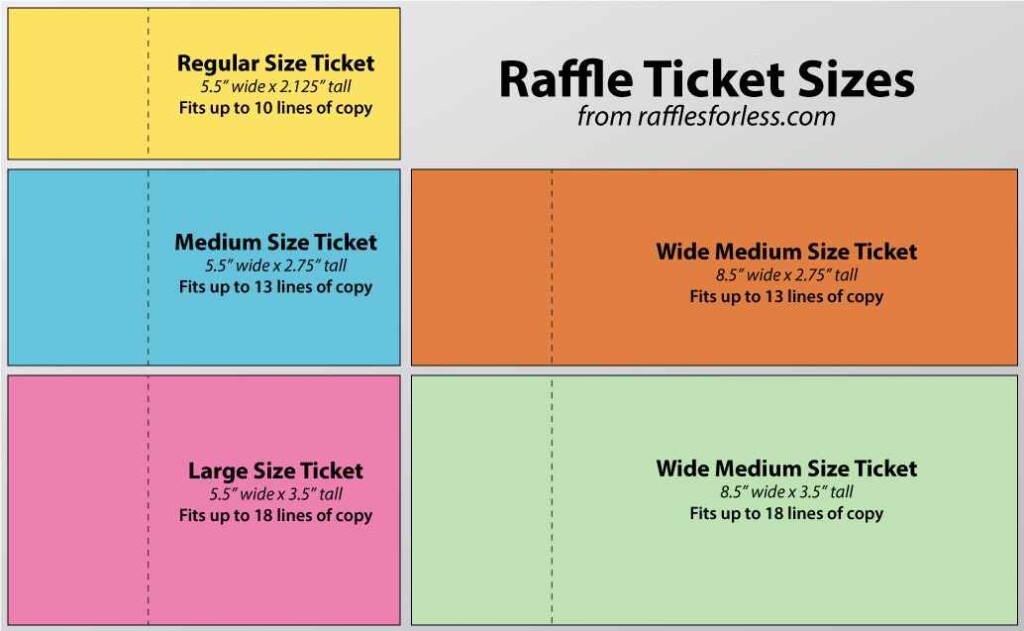
Raffles For Less offers custom printed raffle tickets in several sizes and formats, with options such as perforation, numbering, and different finishing choices.
If you’re planning a fundraiser, you can also review the guide to what information to include on a raffle ticket before finalizing your design.
For organizations comparing ticket formats, the raffle ticket size guide explains the available dimensions and practical uses.
How Ticket Price Can Affect Participation
If you’re organizing the raffle rather than entering it, pricing deserves careful consideration.
A low ticket price may encourage more people to participate, while a higher price may be appropriate for a valuable prize and a targeted fundraising audience.
There is no single correct price for every fundraiser.
Raffles For Less explains several factors that can influence raffle ticket pricing, including fundraising goals, expected sales, prize value, expenses, and audience.
See the guide to how much to charge for raffle tickets for examples and pricing calculations.
Smart Raffle Entry Checklist
Before entering a raffle, ask yourself:
Raffle Research
- I know who is organizing the raffle.
- I have read the official rules.
- I know the entry deadline.
- I know how many entries are eligible, if disclosed.
- I know how many prizes are being awarded.
- I understand the winner-selection method.
- I have checked my eligibility.
Budget
- I know the total amount I am spending.
- The cost fits my budget.
- I am not buying additional tickets just because I have already spent money.
Online Safety
- I am using the organizer’s official website or entry method.
- I am not creating unauthorized duplicate accounts.
- I have saved my confirmation when appropriate.
- I know how legitimate winners will be contacted.
- I will not provide sensitive information to an unverified source.
Odds
- I understand that more entries can improve my probability.
- I know that more entries do not guarantee a win.
- I am not relying on lucky-number theories.
- I understand that previous drawings do not predict future random drawings.
What Happens If You Win a Raffle?
Winning is exciting, but don’t immediately assume the prize is completely tax-free.
For U.S. taxpayers, the IRS states that winnings from lotteries and raffles are gambling winnings and that cash and noncash prizes generally have tax implications. The fair market value of noncash prizes can also be included in income.
The exact reporting and withholding requirements can depend on the circumstances and the type and amount of the prize.
If you win a significant prize, keep your documentation and consider getting tax advice from a qualified professional.
The Bottom Line: Can You Really Improve Your Chances?
Yes, you can make choices that improve your mathematical position, but you cannot guarantee a win in a genuinely random raffle.
The best approach is to look for reasonable odds, understand the entry structure, stay within your budget, read the rules, and participate only in raffles you trust.
If you are asking how to win raffles, remember the most important distinction:
You can improve your odds. You cannot control a fair random drawing.
Avoid anyone promising guaranteed wins. Instead, use probability, careful research, responsible budgeting, and legitimate entry opportunities to make better decisions.
And if you are organizing the raffle, remember that participants are more likely to trust your drawing when your rules, tickets, numbering, and winner-selection process are clear and professional.
Frequently Asked Questions About How to Win Raffles
1. What is the best way to win a raffle?
There is no guaranteed way to win a raffle. Your best legitimate approach is to understand the odds, consider raffles with smaller entry pools, use permitted bonus-entry opportunities, and buy only as many tickets as fit your budget.
2. How to win a raffle with better odds?
Look for a raffle with a relatively small number of eligible entries and multiple prizes. Buying additional legitimate entries also increases your probability, although it never guarantees a win.
3. Can you learn how to win a raffle every time?
No. A properly random raffle cannot be guaranteed. Anyone claiming to have a method that wins every random raffle should be treated cautiously.
4. Does buying more raffle tickets increase your chances?
Yes. If every ticket has an equal chance of being selected, owning more tickets gives you a larger share of the possible winning entries. However, the increased probability comes with increased cost.
5. How to increase your chances of winning raffle draws?
Understand the total number of entries, compare the number of prizes, enter legitimate raffles with favorable structures, and use every permitted entry opportunity. Avoid spending more than your predetermined budget.
6. How to win a raffle online?
Read the official rules, verify the organizer, confirm eligibility, enter correctly, meet the deadline, and use only permitted entry methods. No online strategy can guarantee a win in a genuinely random drawing.