Choosing between custom raffle tickets vs generic ones sounds like a small decision. It isn’t. The ticket is the one thing every buyer holds in their hand, and it’s their first clue that your raffle is real. Generic tickets are fine for a small, private drawing. For anything where the public hands you money, custom tickets are the safer choice, and they cost less than most organizers expect: 1,000 custom tickets start at $37 with us.
Custom raffle tickets carry your organization’s name, event details, prize information, and required legal wording, and they’re printed with matching sequential numbers and perforated stubs. Generic raffle tickets are stock or free-template tickets with no event identity. For public fundraisers, choose custom. For tiny private drawings, generic works.
Below, we compare the two on cost, trust, security, and legal details, show you the real numbers, and tell you when generic is the smarter pick.
What Are Generic Raffle Tickets?
Generic raffle tickets are ready-made tickets that say little more than “Raffle Ticket” and a number. They come as stock rolls from office and party stores, or as printable generic raffle tickets: free templates you download and run through a home printer. Neither type shows your organization, prizes, or draw date unless you write those details in by hand.
Stock Roll Tickets
These are the double-stub tickets sold on rolls. They’re cheap, available the same day, and numbered. The tradeoff is that there’s no room for event details, so organizers end up announcing the prizes and rules out loud or taping a sign to the table. Anyone can also buy the exact same roll at the exact same store, which matters if your raffle involves real money.
Printable Generic Raffle Tickets
Printable generic raffle tickets look like a bargain: download, print, done. For 50 tickets, that can be true. At a few hundred, the work shifts to you. Someone has to number every ticket, cut them apart, and match stubs, and home paper rarely tears as cleanly as a perforated ticket. We break down that tradeoff in making raffle tickets at home, and our comparison of home vs. professional raffle ticket printing covers when the DIY route stops making sense.
What Makes a Raffle Ticket “Custom”?
Custom raffle tickets are designed for one specific organization and event. Your name, logo, colors, prizes, and rules are printed on the ticket itself, so a buyer can see who’s running the raffle and what they’re supporting without asking.
What Goes on a Custom Raffle Ticket
A well-built custom ticket usually includes:
- Your organization’s name and logo
- Event title and drawing date, time, and location
- Ticket price (and any bundle deals, like 6 for $5)
- Prize highlights
- Matching numbers on the ticket and the stub
- Space on the stub for the buyer’s name and phone number
- Any wording your state requires, such as “need not be present to win” or a license number
Our guide to the information to include on a raffle ticket walks through each item.
Custom Printed Raffle Tickets vs. DIY Customizing
Dropping your logo into a free template is customization, but it isn’t the same as custom printed raffle tickets. A professional printer handles the parts that are hardest to fake at home: consecutive numbering, perforation, consistent cuts, and heavier paper in a choice of colors. At Raffles For Less, every ticket is numbered and perforated, you can pick from 20 paper colors, and we can staple or pad tickets into books. Our perforated ticket printing guide explains why that last detail matters more than people think.
Custom Raffle Tickets vs Generic: Side-by-Side Comparison
| Factor | Generic Raffle Tickets | Custom Raffle Tickets |
| Shows your name and cause | No | Yes |
| Prizes, date, and price printed | Handwritten or announced | Printed on every ticket |
| Numbering | Stock roll numbers, or numbered by hand | Consecutive, matched ticket and stub |
| Perforated stub | Roll tickets only | Yes |
| Hard to copy | No, same roll is sold to anyone | Yes, unique design and paper color |
| Upfront cost on very small runs | Lowest | Low (from $33 for 250) |
| Cost per ticket at 1,000+ | Similar or higher once you count your time | Under 4 cents at 1,000 |
| Time to get them | Same day | 24-hour turnaround available |
| Best for | Private, low-stakes drawings | Public fundraisers and events |
Custom Raffle Tickets vs Generic: What the Cost Really Looks Like
This is where most organizers’ assumptions fall apart. Here’s our current regular-size pricing (2-1/8″ x 5-1/2″) on a design-it-yourself order:
| Quantity | Price | Cost per ticket |
| 250 | $33 | about 13 cents |
| 500 | $35 | 7 cents |
| 1,000 | $37 | 3.7 cents |
| 2,500 | $89 | about 3.6 cents |
| 5,000 | $153 | about 3.1 cents |
Look at the first three rows. Going from 250 tickets to 1,000 adds just $4. If you sell tickets for $5 each, a $37 order pays for itself after eight sales. A single buyer who walks away because the ticket looked sketchy can cost you more than the print job.
These prices come from our pricing page, where you can also see larger sizes. Extras like two-sided printing, upgraded card stock, gluing, or stapling change the total, and our Design It For Me service adds $35 or more. Shipping is free. If you’re still deciding what to charge per ticket, see how to price raffle tickets.
Where Custom Tickets Pull Ahead
Trust: Buyers Can’t Check Your Credentials
People at a school fair or church supper don’t know where their money is going. A ticket with your organization’s name, your cause, and a drawing date answers those questions before anyone asks. A blank “Raffle Ticket” slip answers none of them.
To be fair, ticket design alone won’t save a raffle. Prizes, price, and promotion matter just as much, and weak presentation is one of several reasons raffles underperform. We cover the rest in how to avoid a fundraising raffle fail. What a custom ticket does is remove one reason for a buyer to hesitate. For layout ideas, see our raffle ticket design tips.
Security and Record-Keeping
If your raffle has real prizes, you need to be able to prove which ticket won. Matched, consecutively numbered tickets and stubs make that simple. Our guide to raffle ticket numbers explains how numbering keeps a drawing fair.
Here’s a practical trick we recommend: choose a paper color you haven’t used before and change it every year. Someone trying to pass off a photocopied ticket will have a hard time matching your stock.
Legal Wording and Tax Language
Raffle rules vary by state. Some require your organization’s name, the drawing date, or a license number on the ticket itself. Custom tickets let you print exactly what your state asks for. Check your state’s rules in our US raffle laws by state guide, and confirm details with your state’s charity regulator. The National Association of State Charity Officials maintains contacts for each state.
One more thing to get right: don’t print “tax-deductible” on a raffle ticket. The IRS states in Publication 526 that you can’t deduct amounts paid for raffle or lottery tickets as charitable contributions. If you plan to accept separate donations, keep them separate. See are charity raffle tickets tax deductible for more. Nonprofits running raffles should also read the IRS’s Publication 3079 on gaming for reporting rules.
Tickets Double as Marketing
A custom ticket carries your logo and event name into purses, refrigerators, and coat pockets until the drawing. A generic one carries nothing.
When Generic Raffle Tickets Are Enough
We sell custom tickets, but we won’t tell you generic is never the right call. It is, in a few situations:
Pros of generic tickets
- Available today, with no design or ordering
- Lowest cost for a handful of tickets
- No setup effort
Cons of generic tickets
- No identity, so buyers can’t tell who’s running the raffle
- Details have to be handwritten or announced
- Easy to duplicate
- Numbering and cutting fall on your volunteers (for printable versions)
Generic tickets make sense for an office drawing among coworkers, a classroom reward drawing, or a family party. The common thread: no public ticket sales, small stakes, and everyone already knows who’s running it. Even then, if money is changing hands, check your state’s rules first. Ticket type doesn’t make a raffle legal or illegal.
If you’re weighing a free design template against a fully personalized layout, our post on template-based vs custom-designed raffle tickets covers that narrower decision.
Three Real-World Scenarios
These are illustrative examples, not customer case studies.
- School carnival, about 800 attendees. The PTA sells tickets at the door and at game booths. They order 1,000 regular-size custom tickets ($37), put the school name and carnival date on each one, and pick a bright paper color so volunteers can spot valid tickets from across the room.
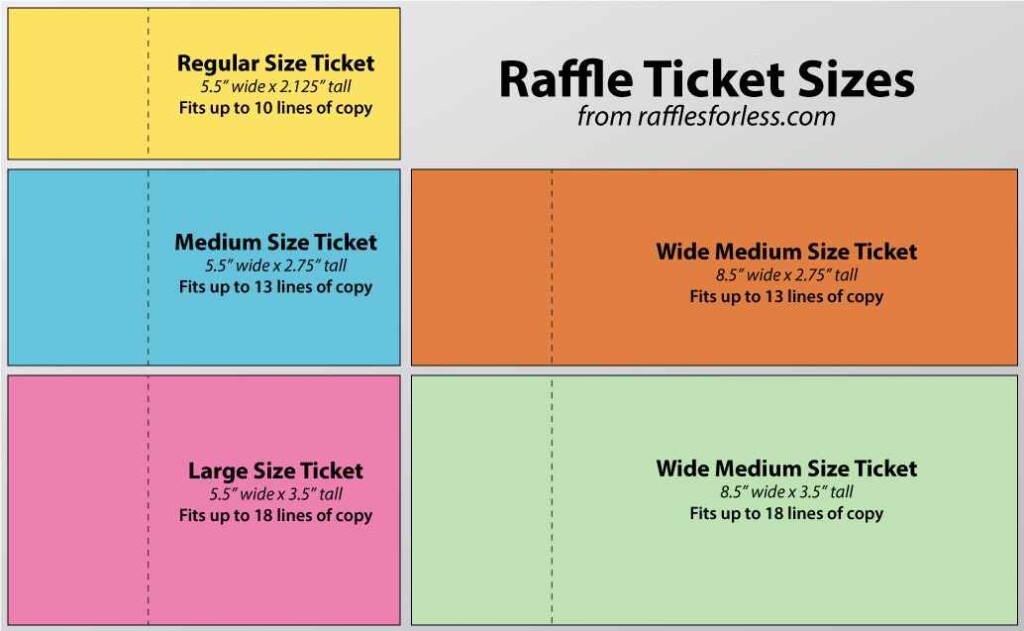
- Church fundraiser dinner with five prizes. The committee wants to list every prize on the ticket and keep a record of who bought what. They go with a large-size ticket (3-1/2″ x 5-1/2″) so there’s room for the prize list, plus a roomy stub for contact info. For 2,000 tickets that’s $131 on a design-it-yourself order.
- Company holiday party, 60 employees. Nobody’s paying, nobody’s a stranger. Generic tickets, or even slips of paper, work fine. If the company wants a sponsor’s logo on them, 250 custom tickets start at $33.
How to Choose in 5 Steps
- Ask who’s buying. Strangers or the general public means custom. Close friends and coworkers means generic may do.
- Ask whether money is changing hands. If yes, you want printed rules, a matched stub, and your name on the ticket.
- Count your tickets. Past about 100, numbering and cutting by hand stops being worth your volunteers’ time.
- Check your timeline. Orders placed by midnight can ship the next business day with us, so “I need them fast” is rarely a reason to go generic. Our fast vs. standard printing post covers the rush options.
- Pick your design path. Design It Yourself is our cheapest option and shows a proof right away. Design It For Me puts one of our designers on your layout.
Ready to build yours? Start on our order forms page.
Mistakes to Avoid
- Using generic tickets for a public raffle. Strangers have no reason to trust a blank slip.
- Printing hundreds of tickets at home. Numbering errors and uneven cuts cause drawing disputes.
- Leaving off the drawing date. Buyers want to know when they’ll hear back.
- Printing “tax-deductible” on a ticket. The IRS says raffle ticket purchases aren’t deductible.
- Skipping the stub. Without a matched stub, you can’t prove who bought what.
- Ordering at the last minute and guessing at quantity. Reordering is easy, but it’s cheaper to plan well.
Best Practices
- Match the ticket size to how much information you need to print. Wide sizes (2-3/4″ x 8-1/2″ and 3-1/2″ x 8-1/2″) fit long prize lists.
- Keep fonts big and the price obvious.
- Use a paper color that’s new each year.
- Number from 1 and keep your unsold tickets together in order.
- Photograph a sample ticket before the event so you always have a master copy.
- Put the same branding on your posters and social posts so the ticket looks like part of one campaign.
Pre-Order Checklist
- State rules checked for required ticket wording
- Organization name and logo ready
- Drawing date, time, and location confirmed
- Ticket price and bundle deals decided
- Prize list finalized
- Ticket size and paper color chosen
- Quantity set (with a small cushion)
- Proof reviewed by two people
Conclusion
When you put custom raffle tickets vs generic side by side, the gap isn’t really about looks. It’s about trust, record-keeping, and whether your ticket works for you or against you. Generic tickets are fine for private, low-stakes drawings. For anything public, custom printed tickets are one of the cheapest ways to look organized and run a drawing you can defend. At 3.7 cents a ticket for 1,000, it’s a small bet on a better raffle.
Ready to see what yours would look like? Start your order here, or compare sizes and prices on our pricing page.
Frequently Asked Questions
What’s the difference between custom raffle tickets vs generic ones?
Custom raffle tickets are printed with your organization’s name, event details, prizes, and required legal wording, plus matching numbers and a perforated stub. Generic raffle tickets are stock or free-template tickets with only a number and the words “raffle ticket.” Custom tickets identify who’s running the raffle; generic ones don’t.
Are custom raffle tickets worth the cost?
For public fundraisers, yes. Custom tickets from Raffles For Less start at $33 for 250 and $37 for 1,000, about 3.7 cents each. That often costs less than one lost sale. They also give you cleaner records and a more trustworthy look than blank stock tickets.
How much do custom raffle tickets cost?
On a design-it-yourself order, regular-size tickets run $33 for 250, $35 for 500, and $37 for 1,000, with free shipping. Larger sizes, two-sided printing, upgraded card stock, stapling, or Design It For Me service raise the price. Check the current pricing page for exact quotes.
Can I make my own raffle tickets at home?
Yes. Printable generic raffle tickets work for small, informal drawings of roughly 50 tickets or fewer. For larger raffles, hand numbering, cutting, and uneven tears create errors and disputes. Professional printing gives you consecutive numbers and clean perforation without the extra work.
Do custom printed raffle tickets sell more tickets?
Not automatically. Prizes, price, and promotion drive most sales. But custom printed raffle tickets remove doubt by showing who’s running the raffle and what it supports, which makes buyers more comfortable handing over money. Think of the ticket as removing a barrier, not creating demand.
What should be on a custom raffle ticket?
Include your organization’s name, event title, drawing date and location, ticket price, prize highlights, matching ticket and stub numbers, and space for the buyer’s name and phone. Add any wording your state requires, such as a license number or a “need not be present to win” line.